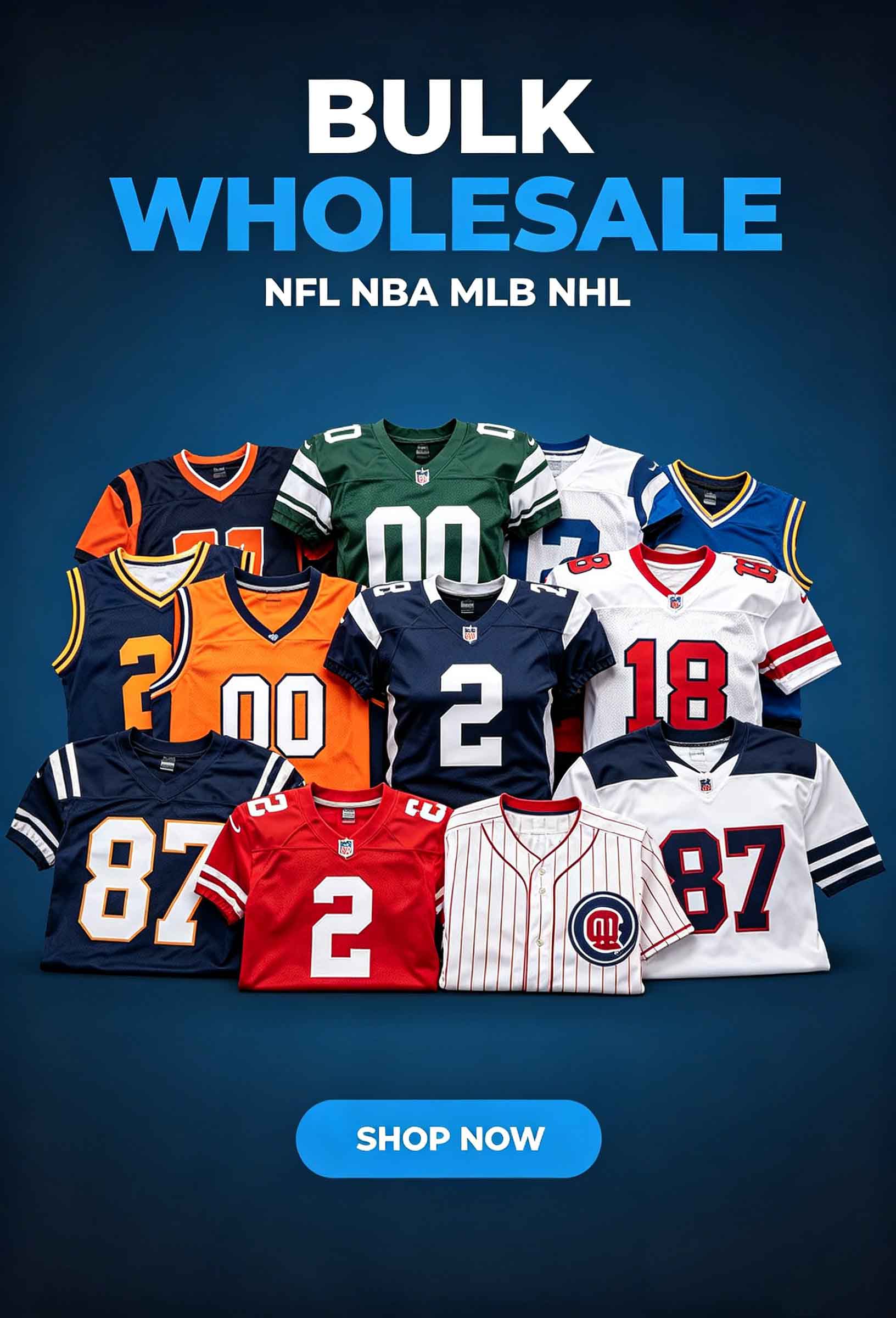
Sourcing custom stitched football jerseys bulk is where most resellers lose their margin — not at the register, but back in the supply chain. Every broker, decorator and freight forwarder standing between the factory and your rack takes a cut and adds another week of lead time. We flipped that model: one warehouse, direct factory allocation, and stitched NFL stock that leaves the dock the same day your PO clears. If you have been paying two or three layers of markup on the same mesh jersey that ships off our floor, this page is the fix.
Start with fabric, because everything else follows from it. Our NFL builds use 100% breathable polyester mesh at a true 300 GSM weight — not the 180–220 GSM tissue that most "cheap stitched" listings quietly ship. Heavier mesh holds its shape through repeated wear, drapes properly on the shoulder, and survives industrial laundry cycles that would shred a light knit in a month.
Here is what the spec sheet actually looks like on a House Shop NFL build:
- Body fabric: 100% breathable polyester mesh, 300 GSM, moisture-wicking finish
- Numbers & letters: double-stitched Tackle Twill, two-layer twill with contrast underlay
- Interior: soft interior backing behind every stitched zone
- Collar: reinforced collar bands with rib-knit stretch memory
- Seams: Z-pattern lock stitch at stress points, flatlock at side seams
- Sizing: US cut, XS through 5XL, plus youth S–XL
The Tackle Twill work is the part buyers inspect first, and it is the part that separates a repeat customer from a refund. Each number is cut from two layers of twill, stacked with a contrast underlay, then stitched down with a dense satin border — not glued, not heat-pressed, not a single-layer print pretending to be embroidery. Run a thumbnail along the edge of the number on a competitor's jersey and you will feel the difference immediately: ours sits flat, tight, with zero lifting at the corners.
Stitch density matters more than most buyers realize. We hold 8–10 stitches per inch on number borders and 12+ on the perimeter of tackle twill nameplates. That density is why our jerseys survive 50+ home washes without the twill curling or the thread fraying. When a distributor asks why our per-unit cost is higher than a heat-press supplier, this is the answer — the labor is in the needlework, and the needlework is what makes the jersey resellable twice.
Inside the jersey, every stitched zone gets a soft interior backing panel. That is the layer that keeps Tackle Twill thread from scratching the wearer's back and chest. On a $19 knockoff, you feel raw thread ends and loose backing within the first hour of wear. On a proper build, the backing is fused flat and trimmed clean, so the jersey feels like a game-day piece instead of a costume.
Collars get abused more than any other part of a football jersey — pulled over helmets at practice, stretched by shoulder pads, yanked in the wash. Our reinforced collar bands use a rib-knit with high elastic recovery, stitched with a double row so the band cannot separate from the body panel. Check the collar first on any sample lot; if the band puckers or the seam shows daylight, the whole run is suspect.
For bulk buyers, fit consistency is the quiet profit killer. A run that measures 22 inches at the chest on one unit and 24 on the next gets you returns, bad reviews, and a dead SKU. Our cutting floor works to a ±0.5 inch tolerance across the chest, body length, and sleeve opening on every graded size. Request a graded spec sheet before you commit — any supplier who cannot produce one is guessing.
Our incoming QC on a bulk lot runs a fixed 12-point check before anything gets racked:
- Fabric weight verified against the approved 300 GSM reference swatch
- Number and nameplate placement measured against the team's official positioning chart
- Stitch density counted on three random units per size break
- Interior backing inspected for loose thread ends and raw edges
- Collar band stretch and recovery tested by hand on five units
- Color match checked under D65 lighting against the team color standard
- Jersey pulled over a size-appropriate form to confirm drape and shoulder line
Pricing works on a straightforward ladder, and the ladder is published, not negotiated in the dark. Small test orders start at a low MOQ so you can validate the quality before committing capital. From there, per-unit cost steps down at defined quantity breaks, and mixed-size cases count toward the same tier. That structure matters for distributors running multiple team accounts — you can combine categories and still hit the deeper discount level.
The custom stitched football jerseys bulk program covers more than blank stock. We handle custom names, custom numbers, sleeve flags, captain patches, and commemorative chest marks on the same production line, using the same twill and the same stitch density. Minimums for a full custom run are set low enough for a single high school booster order, which is exactly the kind of account that keeps a reseller's cash flow moving in the off-season.
Blank stock deserves its own mention. Many league managers and print shops want blank football jerseys wholesale so they can apply their own decoration in-house. We keep solid inventory in core colors year-round — black, white, navy, red, royal, and grey — in both mesh and dazzle finishes, so a local decorator can pull 50 units on Tuesday and have them stitched by Friday.
Size curve planning is where experience pays. Most NFL fan bases skew heavy in L, XL and 2XL — roughly 60% of a typical retail run. If you order an even size break, you will sell out of XL in three weeks and sit on XS for a year. Build your first order at 1-2-3-3-2-1 across S through 2XL, then reorder the middle sizes at double weight. Youth sizes move in team markets and school programs; treat them as a separate SKU with its own curve.
Warehouse depth is the difference between a supplier and a partner. Our House Shop holds deep rack inventory on the highest-rotation teams and colorways, which means restock orders ship in 24–48 hours instead of the 3–5 weeks a factory-direct custom run takes. For resellers, that speed is worth more than a dollar of unit cost — a sold-out jersey costs you the sale and the customer.
Packaging is handled to retail standard: each jersey poly-bagged, folded to a consistent size, with hangtag options available for buyers selling into physical storefronts. Master cartons are packed 20–30 units depending on size mix, with a packing list inside every carton. If you sell on marketplaces that require box-level labeling, tell your account rep up front and we will configure the carton marks to match.
Pass this care sheet to your retail customers and your return rate drops measurably:
- Turn the jersey inside out before washing to protect the Tackle Twill edges
- Cold water, gentle cycle, mild detergent — no bleach, no fabric softener
- Never tumble dry; heat is what shrinks mesh and cracks twill backing
- Hang dry in shade, then steam lightly instead of ironing directly on the numbers
- For stains, blot with cold water and a drop of dish soap; avoid scrubbing the stitch line
Run the margin math before you buy anything. A properly built stitched jersey landed at wholesale typically supports a $75–$120 retail price in team markets, and a 2.5x–4x markup is normal on licensed-look goods. A $4 savings on a jersey that gets returned for a lifted number is not a savings — it is a $30 loss after shipping, restocking, and the customer you never see again.
Team and league buyers should ask three questions of any supplier before signing off: What is the stitch density on the numbers? What is the cut tolerance across graded sizes? Can you ship a restock in under a week? If the answer to any of those is vague, keep shopping. We answer all three in writing on every quote.
Ready to lock in your next run? Head to Jerseys Wholesale House Shop to browse the full warehouse catalog, check live stock depth, and request tiered wholesale pricing. Low MOQ to start, factory-direct delivery on every order, and a discount ladder that protects your resale margin from the first case to the fiftieth.
How long do stitched football jerseys last?
A well-built 300 GSM mesh jersey with double-stitched Tackle Twill and proper care typically holds up for 3–5 years of regular wear, or 50+ wash cycles before the twill edges show wear. Heat-pressed or single-layer builds usually fail within a season because the adhesive releases and the numbers lift at the corners.
Do stitched football jerseys shrink?
Mesh polyester itself does not shrink noticeably, but twill backing and collar ribbing can contract if exposed to high dryer heat. Wash cold and hang dry, and the measurements stay within a half inch of the original spec through the life of the jersey.
What is the minimum order for a custom stitched run?
MOQ is kept low enough to support single-team and school booster orders, and it steps down further at defined bulk tiers. Mixed sizes and mixed team colorways can be combined into one order to reach the next discount level.
Can you ship directly to multiple retail locations?
Yes. Split-shipment distribution is available on bulk orders, with carton-level labeling and packing lists configured per destination. Give your account rep the ship-to list when the PO is placed and we will build the pick sheet around it.