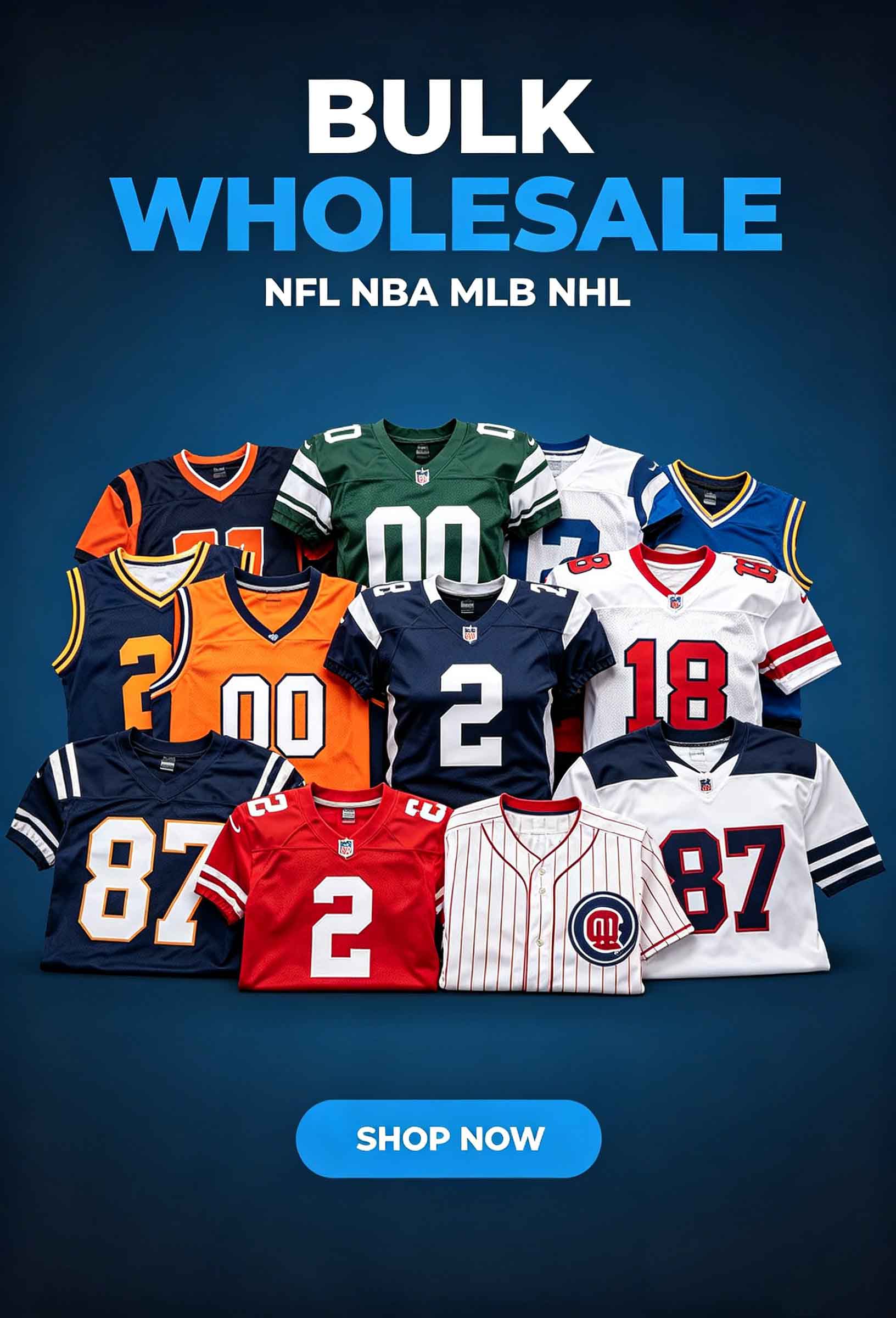
How long do stitched NFL jerseys last in a real game rotation, and how long will they survive before a customer walks back in with a blown seam? That question sits behind every bulk purchase order we process. Buyers who source through three layers of middlemen usually get a jersey that looks fine on the rack and falls apart by week six. Buyers who pull straight from a House Shop warehouse get 300 GSM mesh, double-stitched Tackle Twill, and reinforced collar bands at factory-tier pricing. Here are the real lifespan numbers, the care facts, and the QC checks that protect your resale margin.
Start with construction, because that is what actually determines lifespan. A stitched jersey has its numbers, nameplate, and letters sewn onto the shell with thread. A printed or heat-pressed jersey has graphics bonded with adhesive film. The bond fails first. Thread does not peel, crack, or lift after a hot wash, which is why every serious league account we supply orders stitched product for on-field use.
In practical terms, a quality stitched NFL jersey handles 50 to 100 wash cycles before visible wear shows at the shoulders and hem. Printed replicas typically show cracking between cycle 15 and cycle 25. For a team manager buying 40 uniforms for a two-year program, that difference is the whole budget. One purchasing cycle instead of three.
Fabric weight is the second variable most buyers ignore. Our 100% breathable polyester mesh runs at 300 GSM, a heavyweight knit that holds shape instead of going limp after the first month. Lightweight 180 GSM shells feel soft in hand and look thin under stadium lights. Ask any supplier for the GSM before you commit to a reorder, and ask for it in writing.
The numbers themselves are double-stitched Tackle Twill, layered in two or three color tiers and sewn down with matched thread. Single-layer twill on a single stitch line is the single most common shortcut in this trade. Under game wear, a number corner lifts, snags on a shoulder pad, and tears. Double stitching plus a finished border makes that failure point disappear.
Reinforced collar bands matter more than buyers expect. That is where players grab the jersey, and it is where cheap construction splits first. We specify a ribbed collar with a taped, reinforced band and a second stitch row along the seam. Same story at the shoulder yoke and the side vents, where we run Z-pattern bar tacks to lock the stress points down.
Inside the jersey, soft interior backing covers every embroidery pass. Without it, the reverse side of the twill and thread feels like sandpaper against skin. Youth players complain about it first, then parents call the league director, then the league director calls the supplier. Backing cloth costs a few cents per unit and eliminates the most common return reason in youth and school programs.
Heat is the number one killer of any jersey, stitched or printed. A dryer on high will shrink polyester mesh, warp twill, and set wrinkles into the collar band permanently. A domestic dryer is a controlled heat chamber, and jerseys should stay out of it. Air drying on a line or a rack flattens out and adds years to the garment.
Here is the laundry routine we hand to every league buyer who asks, and it is worth printing on a card for your end customers:
- Turn the jersey inside out before washing to protect the twill surface.
- Machine wash cold, gentle cycle, with a mild detergent and no bleach.
- Skip fabric softener entirely. It coats mesh fibers and traps odor.
- Wash jerseys separately from anything with velcro, zippers, or metal hooks.
- Hang dry or lay flat in shade. Never tumble dry on medium or high heat.
Stain removal follows the same logic. Blot with cold water immediately, then work in a small amount of mild liquid detergent with your fingertips. Do not scrub a brush across Tackle Twill. Agitation frays the thread surface and dulls the twill sheen. Grass and mud lift easily from polyester mesh. Blood, grease, and permanent marker do not, so train your staff to treat those on the spot rather than stacking them in a bin for a week.
Storage decides whether a jersey still looks new at year five. Keep stock in a cool, dry room away from direct sunlight, which fades reds and navy blues fast. Hang on wide-shouldered hangers, or fold with acid-free tissue over the embroidery so nothing presses flat against the twill. Never stack boxes high enough to crush a nameplate, and never store in damp plastic bags.
For bulk programs, the durability question is really a quality control question. Before we release a purchase order, our warehouse runs a fixed inspection protocol on every production lot. If you are sourcing bulk stitched NFL jerseys for resale or for a league, hold your supplier to the same standard.
- Stitch density: 8 to 10 stitches per inch on twill and collar seams. Loose stitching predicts early failure.
- GSM verification: weigh a sample panel against the spec sheet. Claims without numbers are marketing.
- Peel and pull test: twist a number corner and tug the nameplate. Nothing should move.
- Shrinkage check: one cold wash and one low-heat dry. Anything beyond 3% shrinkage fails.
- Colorfastness: submerge a sample in cold water and check for bleeding onto a white cloth.
- AQL 2.5 sampling: pull statistically valid units per lot for major and minor defects.
Sizing is the other quiet margin leak. Our stitched NFL jerseys follow US sizing and generally run true, with a slightly relaxed body that fits over shoulder pads. Adult and youth runs are cut from separate patterns, not scaled down, so a youth large is a proper youth large. Tell your customers to size up only if they plan to layer a hoodie underneath, and remind them that heat shrinkage is preventable, not inevitable.
Reorder consistency is what separates a one-time sale from a repeat account. Teams that buy 24 jerseys in August come back in March for 8 more. That second order has to match the first in shade, twill thickness, and font spacing. We track dye lots and print specs against each customer account, so a reorder ships as a visual twin of the original run, not a near miss.
The margin math is simple once you remove the middlemen. Layered distribution adds 40% to 70% to landed cost before a jersey reaches your shelf. Warehouse-direct purchasing lands you far below retail MAP, which leaves room for volume pricing, team discounts, and still a healthy per-unit profit. Every dollar removed from your cost is a dollar you keep or reinvest into ad spend.
Stock depth protects that margin better than anything else. A hot seller that goes out of stock for two weeks loses the customer permanently. We hold ready-to-ship inventory across adult, youth, and extended sizes, with tiered wholesale pricing that improves as order volume climbs and low MOQ thresholds so small programs and test orders are still worth placing.
How long do stitched NFL jerseys last with weekly wear? Expect five to ten years for a well-made stitched jersey worn once a week and washed cold, air dried, and stored out of sunlight. Printed jerseys in the same rotation generally show cracking inside one to two seasons.
Do stitched jerseys shrink in the dryer? Polyester mesh can shrink up to 5% or more under high dryer heat, and Tackle Twill can curl at the edges. Cold wash and air dry keep shrinkage under 1%.
Is Tackle Twill heavier than screen print? Yes, and that weight is the durability. Sewn twill flexes with the fabric instead of cracking across it, which is why it survives collisions, pads, and long seasons.
How should I store jerseys before resale? Cool, dry, out of sunlight, hung on wide hangers or folded with tissue over the embroidery. Avoid damp plastic, direct heat, and heavy stacking.
If you want stock that holds up to these numbers, pull from a supplier that owns the inventory and controls the stitching. Browse the Jerseys Wholesale House Shop NFL warehouse catalog to see current depth, grading, and tier pricing, then request a sample pack before you scale. Orders ship factory-direct from www.jerseyswholesalehouse.shop with fast bulk dispatch, transparent landed pricing, and low MOQ entry points, so you can test a design, watch how it sells, and reorder the winners without tying up your cash.