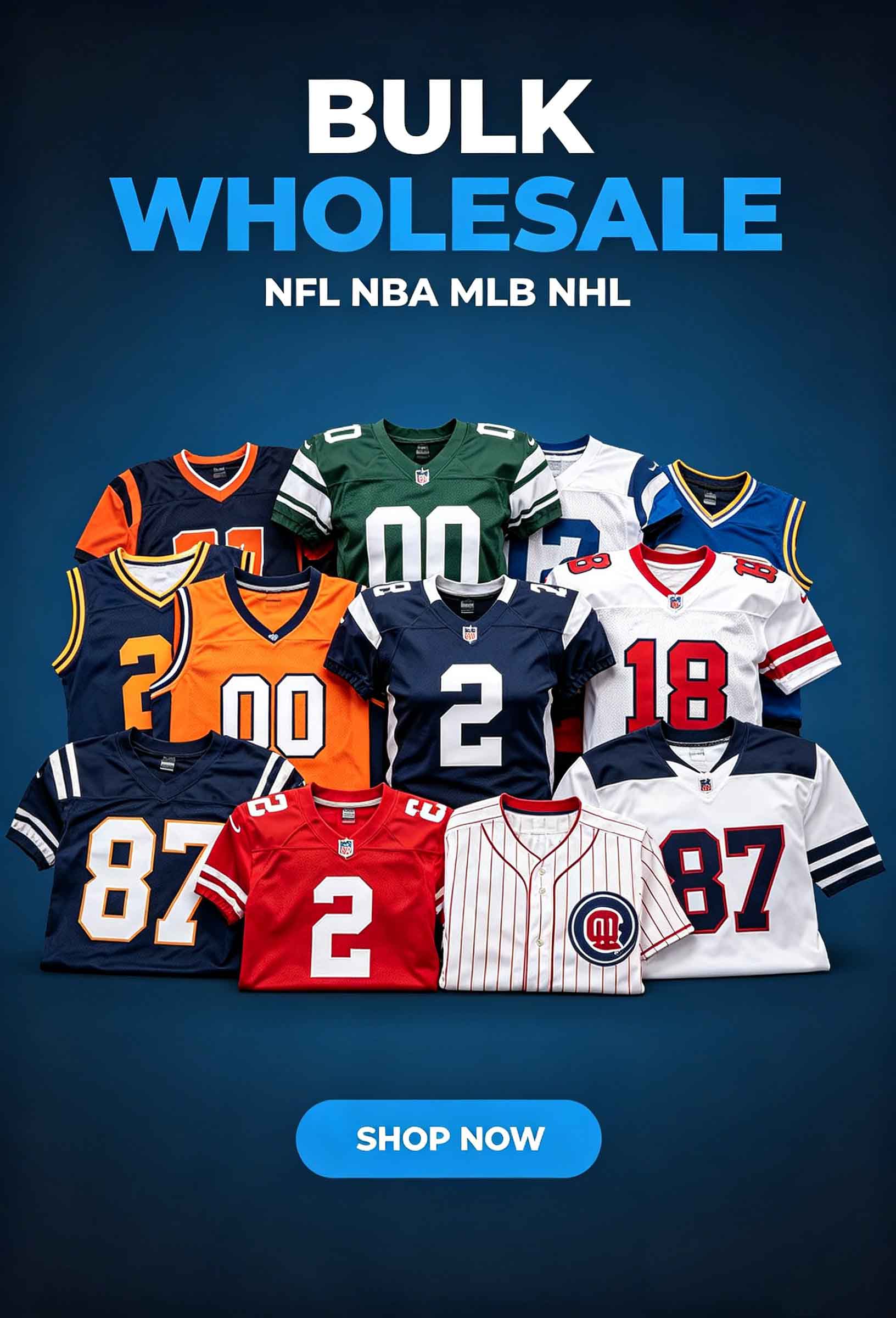
If you are sourcing custom stitched baseball jerseys bulk for a league, a school program, or a resale shop, the math usually falls apart before the product even ships. Two or three middlemen take their cut, lead times stretch past opening day, and the stitched numbers show up with loose threads. Jerseys Wholesale House Shop removes that chain. We hold MLB-style stock in our own warehouse, quote tiered pricing by volume, and pull large orders for fast dispatch.
Sourcing managers ask the same three questions before they commit to a container: what is the fabric weight, how is the lettering attached, and what does the price do at 50, 200, and 500 units. We answer all three in writing. Every quote lists the mesh spec, the stitch type, the collar construction, and the exact price break table for that style.
Start with the shell. Our baseball jerseys are cut from 100% breathable polyester mesh at 300 GSM on heavyweight bodies, with a lighter 220 GSM option for youth and practice sets. That number matters. Anything under 180 GSM turns transparent under stadium lights and sags after two washes, which is the fastest way to lose a repeat buyer.
The placket is where cheap jerseys expose themselves. Ours runs a full button-down front with a fused interlining, so the buttons stay on plane after repeated laundering. The reinforced collar bands are taped and double-needle stitched, meaning the neckline holds its shape instead of curling up by midseason.
Numbering is the second tell. We build with double-stitched Tackle Twill numbers — a twill base layer with a stitched border on top — locked down with a zigzag stitch around every edge. That construction does not peel, and it does not lift at the corners the way heat-pressed vinyl does after a dozen wash cycles.
Inside fit counts too. Every stitched panel gets a soft interior backing so the embroidery never scratches a player's shoulders or chest. Youth sizes get the same treatment, not a downgraded version. That single detail is why league directors reorder instead of shopping the market every spring.
- Shell: 100% breathable polyester mesh, 220–300 GSM
- Lettering: double-stitched Tackle Twill numbers with zigzag edge lock
- Collar: reinforced, taped, double-needle stitched band
- Placket: full button-down front with fused interlining
- Interior: soft backing cloth behind all stitched zones
- Sizes: youth S–XL, adult S–4XL, custom cuts available
On sizing, the question we field most is whether baseball jerseys run big or small. Our adult bodies follow a classic baseball cut — roomier through the chest, slightly shorter sleeve — and they run true to that pattern. Order one sample per size run, measure it flat against a jersey your team already wears, then lock the roster list.
Do not guess on youth sizing. Coaches usually want room to grow, but a jersey two sizes up looks sloppy in photos and drives returns for resellers. Print a chest-width table in your listing and you will cut size-related refunds dramatically.
Our custom stitched baseball jerseys bulk program covers roster names, front and back numbers, sleeve patches, and team script. Send a spreadsheet with player names and numbers and we map it to the style you selected. No per-unit art setup fee on stock styles.
Blank baseball jerseys wholesale is the other half of the business. Many distributors buy blanks and handle local printing or embroidery themselves. We keep a deep blank inventory in navy, royal, red, white, grey, and black so you are never stuck waiting on a dye lot.
Pricing is volume-tiered, and the tiers are real numbers, not a "call us" placeholder. Typical breaks land at 25, 50, 100, 250, and 500 units, with the sharpest landing around the 250–500 mark. Low MOQ orders under 25 units are still accepted at the entry tier, which lets new shops test a category before committing capital.
Before anything ships, orders run through a four-point inspection. Stitch density at the numbers, seam integrity along the shoulders and side vents, button retention, and color consistency against the approved swatch. We pull samples from the top, middle, and bottom of every carton.
Our AQL standard is 2.5 for major defects and 4.0 for minor ones on bulk runs. That means a crooked chest number or a missed thread lock gets pulled before it reaches your customer. If you want a third-party inspection on a large order, we will stage the goods and coordinate access.
Lead time is where most overseas suppliers lose accounts. Stock styles with stock decoration ship in 3–7 business days. Full custom roster builds with new artwork run 10–18 business days depending on volume. If your season starts in three weeks, tell us the deadline up front and we will quote only what can actually land.
Restock cycles matter for resellers. We hold recurring inventory on the top-moving mesh bodies rather than buying one-time lots, so a style you sold out in May is still orderable in July. Ask for the current warehouse snapshot before you build a catalog page around a colorway.
Care instructions are worth passing to your buyers because they protect your margin. Wash inside out in cold water, skip the fabric softener, and never put a stitched jersey in a hot dryer. Heat is what causes shrinkage and dulls the twill. Hang dry and the body keeps its cut.
On shrinkage specifically, our mesh shells are pre-shrunk and stabilized, so a proper cold wash and hang dry produces minimal movement — generally under 2%. A hot dryer can push past that, which is why the care tag says what it says.
For stains, blot immediately rather than rubbing. A little dish soap on a soft brush handles grass and dirt. For grease, a dab of degreaser before the wash cycle. Never scrub a stitched number directly; you will fray the twill edge and the damage is permanent.
Storage is simple. Fold at the waist, keep jerseys off wire hangers for long periods, and store in a dry bin away from direct sun. UV fades mesh faster than washing does, especially on reds and royals.
Packing gets attention too. Bulk cartons are poly-bagged by size, labeled by style and colorway, and palletized for freight. If you are distributing to multiple retail locations, we can split cartons by store allocation so your team is not repacking in the back room.
Run the profit math before you order. A stitched mesh jersey sourced at the wholesale tier, shipped at a low per-unit freight cost, and retailed at standard market pricing typically leaves a healthy spread even after you discount for team volume. Cutting out two layers of distribution is what creates that room.
Q: What is the minimum order for custom stitched jerseys?
We start at 25 units per design for stock styles. Larger runs unlock better tier pricing, and mixed-size orders count toward the same tier.
Q: Can you match a specific team color?
Yes. Send a Pantone number or a physical swatch. We will confirm against the mesh dye lot before production starts.
Q: How long do stitched baseball jerseys last?
With cold washing and hang drying, a double-stitched Tackle Twill jersey holds up for multiple full seasons of regular use. The stitch construction, not the fabric, is what determines longevity.
Q: Do you drop-ship or ship to my warehouse?
Both. We ship direct to your facility, to individual league addresses, or on your freight account if you prefer to control the carrier.
Ready to lock in pricing? Head to www.jerseyswholesalehouse.shop to browse the full MLB warehouse catalog, check live stock, and request a tiered quote for your next roster order. Low MOQ entry, factory-direct pricing, and dispatch you can plan a season around.