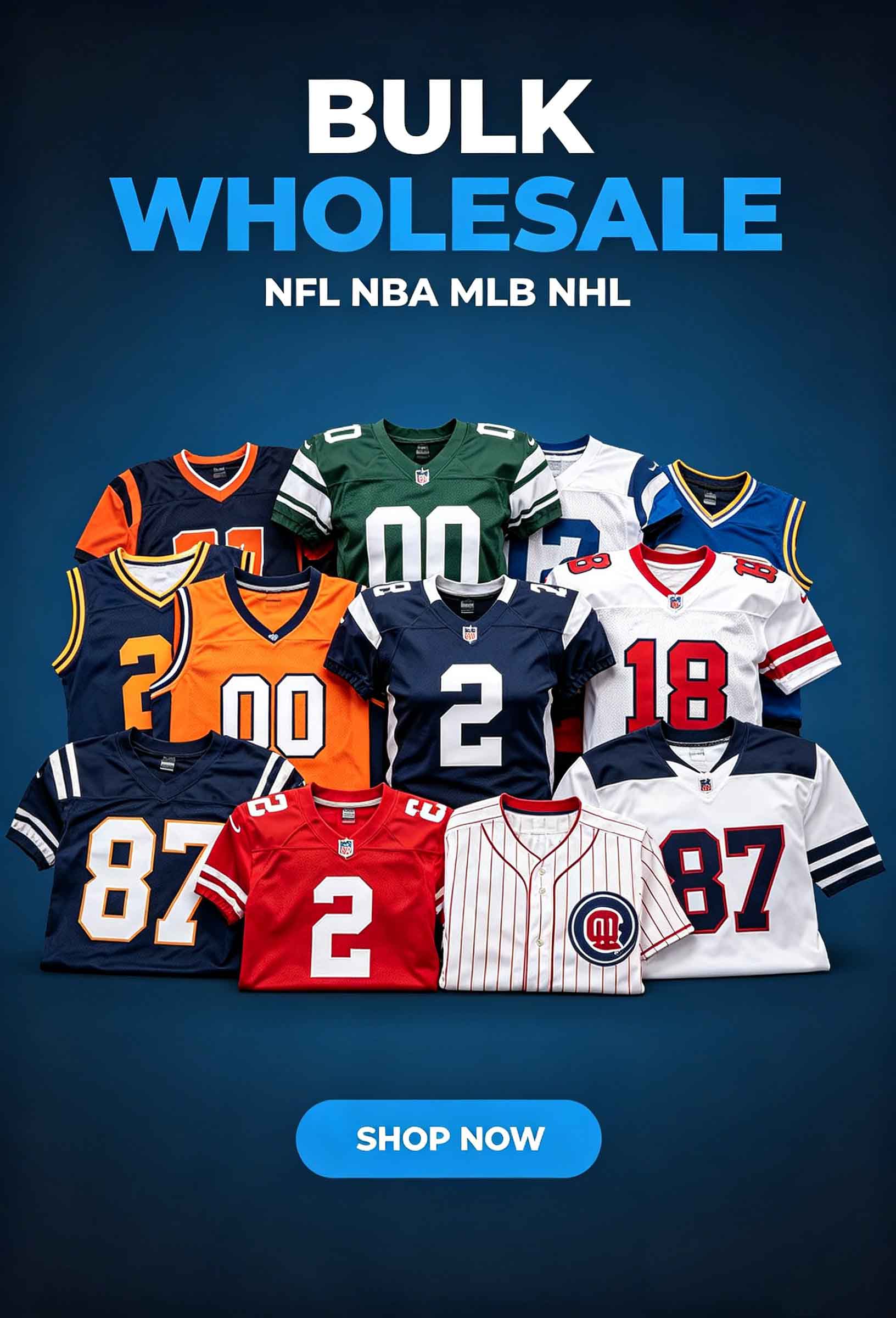
Bulk buyers searching for custom stitched football jerseys bulk run into the same wall every season: the supply chain adds cost without adding quality. When you place custom stitched football jerseys bulk orders through a middleman, you pay for freight, storage, and markup before a single stitch reaches your shelf. That means thin margins, late restocks, and tackle twill that lifts after two washes. League managers and reseller buyers are moving to direct House Shop sourcing for one reason — the warehouse controls the stitching line, the stock count, and the price tier.
Start with fabric weight, because it decides whether a jersey survives a full season. Our House Shop football stock runs on 300 GSM heavyweight mesh built from 100% breathable polyester mesh. That weight holds shape through shoulder pads, huddles, and repeated wash cycles without turning transparent under stadium lights.
Cheap suppliers cut mesh density to save yarn. The jersey feels fine in the poly bag and looks flat by week three. A 300 GSM body keeps drape and color depth, which matters when your buyers compare your product against a pro shop rack.
Numbers and nameplates are where bulk orders live or die. Every jersey in this program carries double-stitched Tackle Twill numbers — two separate twill layers, each locked down with dense edge stitching, not a printed patch glued to the mesh.
Tackle Twill adds a raised, matte finish that photographs well and holds up to abrasion. Single-stitch imitations curl at the corners after a few laundry cycles, and that is exactly the complaint that kills repeat orders for a reseller.
The inside of the garment gets equal attention. A soft interior backing sits behind every embroidered number and letter so the stitch tails never scratch a player's skin. Youth programs notice this immediately, and parents notice it faster.
Collars take the most abuse in football. Reinforced collar bands with zig-zag lock stitching keep the neckline from stretching into a wave after a dozen pulls. Shoulder seams and armholes get the same treatment, since those are the two stress points that fail first on low-grade stock.
Trade buyers should ask one question before any bulk commitment: who owns the embroidery machine? When the answer is a trading company, you are paying a layer of margin for a spec sheet they cannot verify. Direct warehouse sourcing removes that layer and shortens the replacement cycle.
Stock depth is the second half of the equation. A supplier with 40 units in three sizes is not a wholesale partner, it is a sample shop. House Shop reserve inventory is held in full size runs from Youth S through Adult 4XL, so a reorder does not stall your storefront for three weeks.
If you want to compare mesh weight, stitch density, and size breaks side by side, the custom stitched football jerseys bulk program lists every spec before you commit to a purchase order.
Sizing is the quiet profit killer. Football jerseys are cut to layer over pads, so a size that fits a fan as a shirt may run tight on a player. Our cut runs true to a standard athletic fit with roughly 2 to 3 inches of chest ease over a bare measurement.
- Youth S–XL: flat chest measurement plus 2 inches for pad clearance
- Adult S–2XL: standard athletic cut, true to size for most buyers
- Adult 3XL–4XL: extended body length, reinforced side seams
- Sleeve length: short and long options on the same mesh base
Order a size run sample before a large commitment, then measure a washed garment, not a fresh one. Mesh relaxes slightly after the first cold wash, and your published size chart should reflect the post-wash number.
Inspection standards separate professionals from hobby sellers. Pull a random 10 percent of any incoming carton and run four checks: stitch count per inch at the number edge, twill alignment against the jersey centerline, collar band recovery after a stretch, and color match between the body and the sleeve panel.
Reject a batch when the twill edge shows fewer than 8 to 10 stitches per inch, when the number sits more than 3 mm off center, or when the collar stays stretched after release. Document the failure with photos and a carton number. Good suppliers correct it; weak ones argue.
Pricing works on tiers, not guesswork. Volume brackets reward planning: the more units per style and size mix, the lower the per-unit landed cost. That structure lets a distributor price below local retail and still hold a healthy spread.
- Sample tier: single units for fit and finish approval
- Team tier: mixed sizes for league and school programs
- Distributor tier: pallet-level volume with the lowest unit cost
- Reorder tier: repeat styles held at the negotiated bracket
Low minimum order thresholds matter for new resellers. You should be able to test three team styles without sinking capital into a container. Start narrow, read the sell-through, then scale the winners into the next bracket.
Customization is where margin hides. Names, numbers, sleeve patches, and chest marks can all be stitched to your league or store spec. Confirm font style, twill color code, and stitch thread color in writing before production, because a shade difference on a navy twill is obvious under daylight.
Packing decisions affect your labor cost. Flat-fold with a size sticker on the poly bag cuts receiving time compared to loose cartons. Ask for size-segregated bundles if you ship to multiple team managers, and confirm the carton manifest matches the packing list.
Care guidance belongs on your product page, not in a reply email. Tell buyers to wash cold, turn the jersey inside out, skip fabric softener, and hang dry. Heat is the enemy of mesh and twill; a hot dryer shrinks the body panel and dulls the embroidery sheen.
For stain removal, blot first, then use a mild detergent and a soft brush on the mesh only. Never scrub the twill edge, and never bleach a colored panel. Store jerseys folded in a dry space away from direct sun, which fades dyed mesh faster than most buyers expect.
Run the math before you buy. If your landed cost per unit sits at a distributor tier and your local market sells comparable stitched product at retail, the spread typically covers shipping, payment fees, and a workable profit. Thin-margin resellers usually bought at the wrong tier, not the wrong product.
Delivery reliability closes the loop. Factory-direct dispatch from a stocked warehouse shortens the gap between purchase order and shelf-ready cartons. Confirm the cut-off time for same-day picking, the carrier handoff, and the tracking feed before your first peak-season order.
Q: How long do stitched football jerseys last?
A well-built 300 GSM mesh jersey with double-stitched Tackle Twill typically holds up through a full multi-week season plus regular washing. Longevity depends more on wash temperature and dryer heat than on the stitching itself.
Q: Do these jerseys run big or small?
They run true to a standard athletic cut with pad clearance built in. Buyers who want a loose fan fit should size up one; players wearing pads should follow the chest measurement chart.
Q: What is the minimum order for custom names and numbers?
Minimums are set per style rather than per size, so a mixed size run counts toward the same threshold. Confirm the current bracket with the warehouse before finalizing a team order.
Q: Can I reorder the same style later at the same price tier?
Repeat styles are held at the negotiated bracket when the size mix matches the original order. Keep your style codes and twill color codes on file to avoid shade drift on reorders.
Stop paying a middleman for stitching he never touches. Review the full Jerseys Wholesale House Shop NFL warehouse catalog at www.jerseyswholesalehouse.shop to see live size runs, tiered wholesale pricing, low minimum thresholds, and factory-direct dispatch that keeps your shelves stocked and your margins intact.