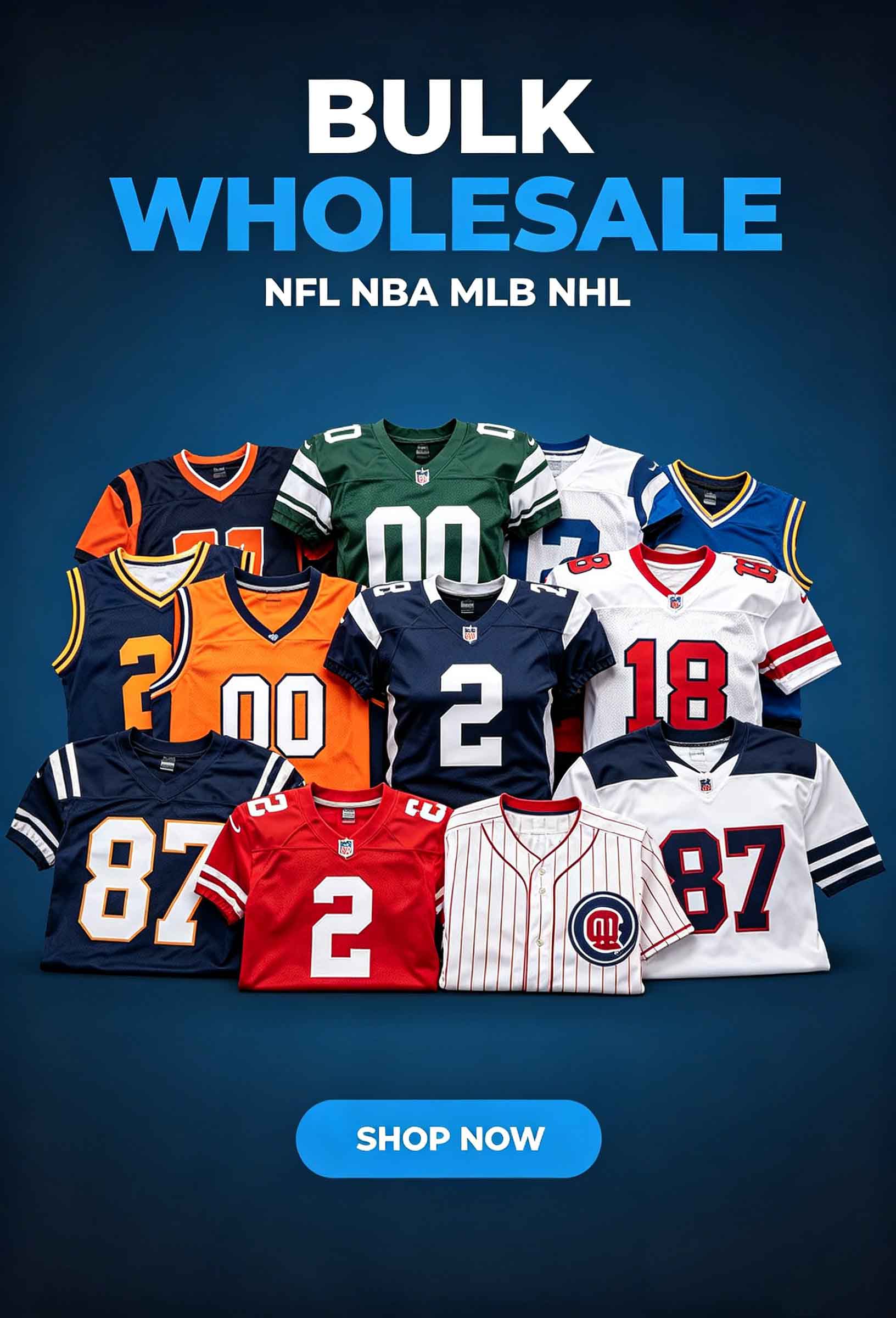
If you are sourcing custom stitched football jerseys bulk for a store, a league, or a distributor network, the first thing that kills your profit is the middle layer. Every broker between the stitching floor and your loading dock adds 15% to 30% and rarely stocks deep size runs. We cut that layer out entirely, which is why buyers keep coming back to our NFL house shop.
This is not a drop-ship operation. We hold physical inventory in our own warehouse, run our own QC bench, and ship full cartons on the same schedule for a 12-piece test order and a 1,200-piece program.
When a buyer says "stitched," they usually mean one of three things: heat-pressed vinyl that peels in a season, single-layer stitched twill that puckers, or genuine double-stitched Tackle Twill. Only the third one survives retail returns. Here is exactly what separates the tiers.
- Fabric: 100% breathable polyester mesh, 220 GSM standard / 300 GSM heavyweight option
- Numbers & letters: double-stitched Tackle Twill, zig-zag reinforced borders
- Inside finish: soft interior backing so numbers never scratch the skin
- Collar: reinforced collar bands with ribbed stretch that holds shape
- Stitch density: 8–10 stitches per inch, locked at the corners
Stitch density is the number most suppliers hide. Anything under 7 stitches per inch frays after 20 washes, and that is the exact failure point that generates chargebacks from your customers. We pull random units from every bulk lot and run a stitch-pull test with a 5 lb load on the number edge.
The interior matters more than most buyers realize. A heavy twill number pressed flat against a player's back rubs raw during a full game. Soft interior backing panels are heat-bonded behind the twill, so the jersey reads premium the second someone picks it up.
Collar construction is the second silent failure point. Cheap collars stretch out after two washes and start waving. Our reinforced collar bands use a ribbed knit with a woven stabilizer strip, which keeps the neckline flat through repeated laundering.
Mesh weight changes how the jersey photographs. A 220 GSM mesh is the standard weight buyers expect at the retail shelf, while 300 GSM heavyweight mesh is what vintage and throwback programs need to look period-correct. Both run on the same line, so a mixed bulk order stays on one production schedule.
Color matching is handled with lab dips before a bulk run starts. If your store already carries team colorways, send a physical swatch and we will match against it rather than against a screen rendering. Digital files lie; a swatch does not.
Now to the warehouse side. Stock depth is what separates a real distributor from a guy with a spreadsheet. Our size runs go S through 5XL on core teams, with youth sizes S–XL held separately so youth programs are not competing with adult inventory.
If you are sourcing custom stitched football jerseys bulk, ask three questions before you commit: what is the in-stock size curve, what is the restock cycle on the SKU, and what happens when a size breaks mid-run. A supplier that cannot answer all three will stall your reorder.
Our restock cycle on core NFL inventory runs every 14 to 21 days, with priority allocation going to accounts that order on a recurring schedule rather than one-off spikes. That is how you avoid the dead zone where your best-selling size is gone for six weeks.
Tiered pricing is straightforward and published to your account manager on request. The structure works on quantity breaks at 12, 48, 144, 600, and 1,200 units, and mixed team orders count toward the same break as long as the total quantity clears the threshold.
Low MOQ is intentional. We would rather have a buyer test 12 units, sell through them, and come back for 300 than force a 200-piece commitment and lose the relationship. Test orders ship from live warehouse stock, not from a production queue.
Custom names and numbers change the workflow, so plan for it. Submit a roster in a clean spreadsheet with name, number, and size per line. Spelling errors on a 300-piece run are expensive, so we send a digital proof back for sign-off before the stitching floor starts.
Bulk QC standards for buyers running their own inspection:
- Measurement tolerance: ±1 cm on chest, body length, and sleeve
- Number alignment: centered within 3 mm of the spec sheet centerline
- Colorfastness: no transfer after 3 crock tests and 5 home launderings
- Thread trim: no loose tails over 4 mm inside or outside the garment
- Shrinkage: under 3% after one cold wash and hang dry
Fit questions come up constantly from resellers who need to answer their own customers. Stitched mesh football jerseys generally run a half size larger than a fitted cotton tee because the cut is built for shoulder pads and layering. If your customer is between sizes, sizing down gives a cleaner retail fit.
Give your buyers the care instructions that protect your return rate. Cold wash inside out, mild detergent, no fabric softener, no tumble dry. Fabric softener coats the mesh and dulls the twill sheen, which is the fastest way to make a new jersey look three years old.
For stain removal, treat immediately with a diluted dish soap solution and a soft brush, working from the outside of the stain inward so you do not spread it. Never use chlorine bleach on colored mesh, and never iron directly over stitched twill — use a pressing cloth on low heat if wrinkles matter.
Storage matters for seasonal sellers. Hang on a wide-shouldered hanger rather than folding, because long-term creases in twill can become permanent. Skip sealed plastic bags for anything over a month; mesh needs airflow or it develops a musty odor that buyers notice instantly.
Logistics for bulk accounts are built around carton efficiency. Jerseys pack 30 to 50 per carton depending on size mix, and we consolidate multi-SKU orders so you are not paying for half-empty boxes. Dispatch from warehouse stock is typically 1–3 business days after payment clears.
Margin math is where the house shop model shows up. When you buy factory direct instead of through two resellers, your landed cost per unit drops enough to absorb shipping and still keep 45% to 60% gross margin at typical online retail pricing. That spread is what funds your ad spend and your markdowns.
League and team managers should order early and lock a numbering format upfront. Retired numbers, duplicate numbers within one roster, and name-bar versus direct-sewn lettering all need a decision before production, not after. Getting that settled in the proof stage saves an entire rerun.
Restock planning is simple once you have sales data. Track sell-through by size for your first two bulk orders, then weight your reorder toward the sizes that actually moved instead of reordering the original curve. Most stores lose money on size 3XL and gain it back on M through XL.
We also hold throwback and vintage colorway inventory for programs that sell nostalgia. Vintage embroidered football jerseys move slower but at higher margin, so a small allocation of 20 to 40 units per style is usually the right risk position for a first run.
One last operational note for distributor buyers: ask for a pick list with every shipment. Carton counts, SKU breakdown, and size counts per carton should match the invoice exactly. If a supplier resists giving you that document, they are not running a real warehouse.
FAQ
What is the minimum order for custom stitched football jerseys bulk?
Blank stitched stock starts at 12 units and can mix teams, sizes, and colorways. Custom names and numbers start at 24 units because the stitching setup has to be built per roster.
How long does a custom stitched bulk order take?
Stock-only orders dispatch in 1–3 business days. Custom stitched orders with names and numbers typically run 12–18 business days after proof approval, depending on total quantity.
Can I mix youth and adult sizes in one bulk order?
Yes. Youth S–XL and adult S–5XL both count toward the same quantity break, and they ship in the same consolidated carton group unless you request separate packing.
Do stitched numbers hold up after repeated washing?
Double-stitched Tackle Twill with 8–10 stitches per inch and locked corners holds its edge well past 50 cold-wash cycles. Heat-pressed vinyl will not, which is why we do not sell it as a stitched option.
If you are ready to stop paying middlemen for inventory you cannot verify, pull up the full Jerseys Wholesale House Shop catalog and request the current stock sheet with tier pricing. Low MOQ, warehouse-direct dispatch, and factory pricing on every tier mean your first order can be small and your margin can be real.