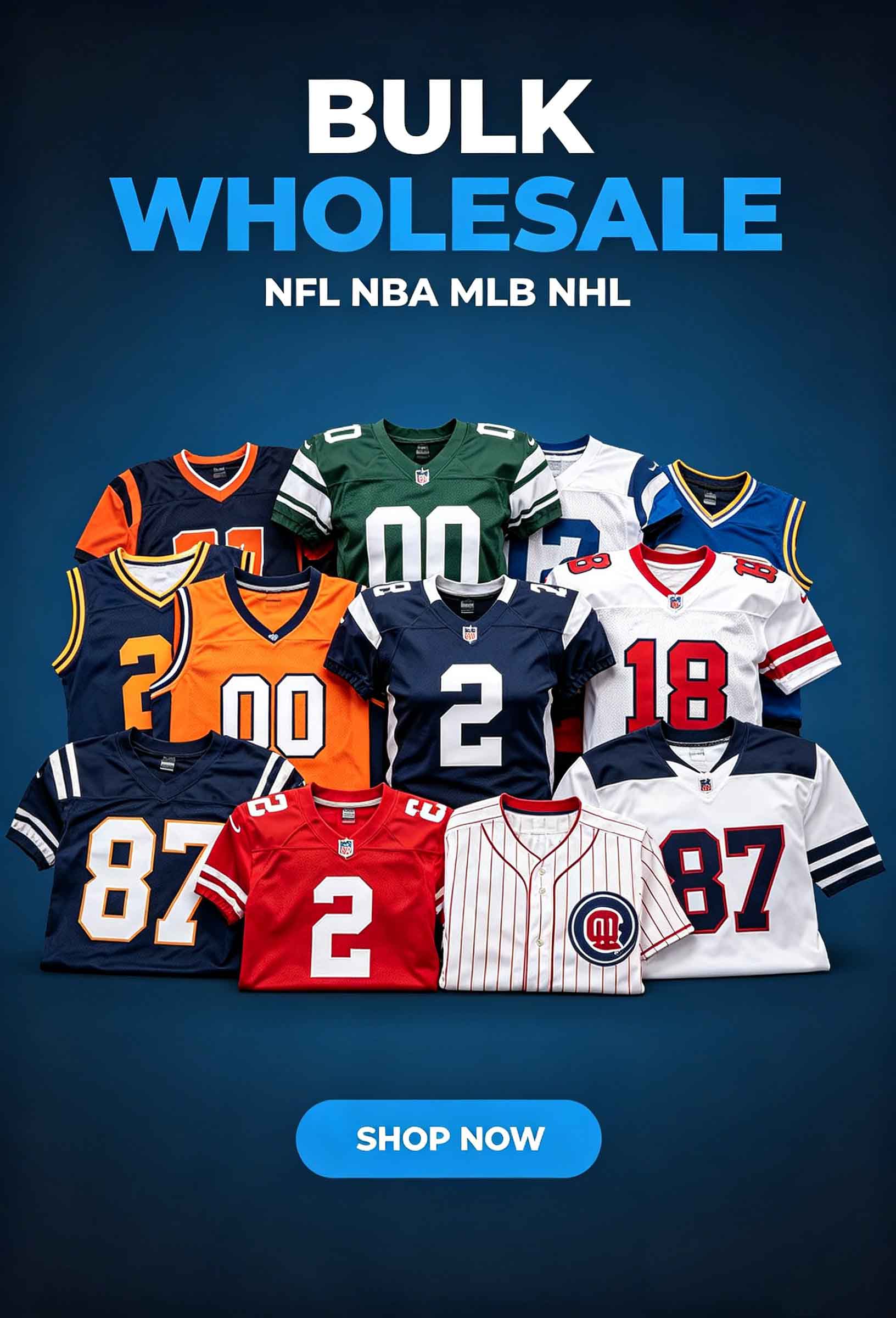
If you are sourcing custom stitched football jerseys bulk for a league, team store, or distributor account, the fastest way to lose margin is to buy through layers of middlemen. Jerseys Wholesale House Shop cuts that chain with factory-direct NFL jersey stock, transparent tier pricing, and a warehouse program built for buyers who need consistent stitching, reliable size runs, and fast replenishment.
Most bulk buyers get squeezed in three places: the unit price, the freight and lead time, and the defect and return rate. A quote that looks cheap per piece often arrives 45 days late, with three sizes missing and a batch of numbers lifting at the corners. That is not a wholesale deal. That is a cash-flow problem with a tracking number.
The House Shop model is simpler. Core NFL styles sit in warehouse stock, ready for mixed-size and mixed-color orders at tiered wholesale pricing. Low MOQ thresholds let a reseller test a team, a colorway, or a local market without tying up thousands in slow inventory. When the reorder comes, the spec sheet and stitch profile are already on file.
Material is where the margin argument starts. Our game jersey build uses 300 GSM 100% breathable polyester mesh, not the paper-thin mesh that looks fine in a photo and fails after two washes. The heavier gauge holds its shape on a hanger, resists snagging at the shoulder and side panels, and moves air during sideline or summer league use.
Stitching is the detail that decides whether a bulk order becomes a repeat order. Our custom stitched football jerseys bulk program uses double-stitched Tackle Twill numbers and letters, with two rows of lockstitch around the perimeter and Z-stitch reinforcement at high-stress points. The twill is cut clean, layered flat, and stitched without puckering.
Inside the jersey, soft interior backing sits behind the embroidery and twill. This matters for youth teams, school programs, and any buyer who has had a player complain about scratchy thread against the skin. Reinforced collar bands and shoulder seams protect the shape through repeated wear and wash cycles.
When you inspect a bulk lot, do not just look at the front number. Check number height tolerance, alignment to the center seam, thread color match, backing smoothness, and loose thread trimming. A good batch should show consistent placement across sizes, not a front number that sits a half-inch lower on the 3XL than it does on the medium.
Our warehouse QC protocol is built around AQL 2.5 sampling, with 10% spot checks on large bulk runs. We measure chest, body length, and sleeve length against the size chart, check collar recovery, run a three-cycle wash test on random pieces, and pull seams at the armhole and side vent. Batch photo reports are kept on file so reorders match the last shipment.
Sizing is a common source of returns. Football jerseys are cut roomy, so do not blindly size up. Measure a player’s chest, shoulder width, and preferred fit, then allow for pads only if the jersey is for game use. A standard bulk size run should include youth S-XL, adult S-3XL, and a clear note on 2XL and 3XL cost differences.
Custom names and numbers need a written spec, not a text message. Send a roster spreadsheet with exact spelling, number range, font style, sleeve patch placement, and any team logo requirements. Approve a digital proof before the run starts. Save that proof in your account file so the next season’s reorder does not become a new design project.
Bulk pricing math should include landed cost, not just the unit price. Add freight, duties if applicable, a defect allowance, and spare pieces for replacements. A 50-piece tier may look attractive, but if the freight per unit is high, the 100-piece tier can deliver a better real margin. Keep 8-10% spares on custom team orders, especially in youth sizes.
Inventory strategy should split core stock from custom work. Keep fast-moving NFL teams and basic colorways in warehouse stock for immediate resale. Use custom stitched production for league accounts, fundraisers, and team stores with a known roster. This keeps cash moving while still allowing buyers to offer names, numbers, and team-specific details.
Care instructions reduce returns more than most resellers expect. Tell buyers to wash cold, inside out, with mild detergent, and no fabric softener. Hang dry. Do not iron directly over Tackle Twill; use a press cloth on low heat if needed. Store folded or on a wide hanger. A jersey that is treated like a game uniform will last far longer than one that goes through a hot dryer every week.
Stain removal should also be part of your after-sale guide. Mud and grass come out best with cold water and an enzyme detergent. Blot, do not scrub hard. Blood stains need cold water only. Skip bleach and harsh spot treatments on mesh and twill. If a customer follows those basics, most complaints about fading or stiff numbers disappear.
Common bulk mistakes are predictable. Ordering exact counts with no spares, ignoring dye-lot differences between reorders, not confirming name spelling, and assuming all mesh is the same weight. Another mistake is buying on unit price alone without checking stitch density or collar construction. A sample before a full run costs far less than a returned batch.
Dispatch speed matters when a league season is approaching. House Shop stock orders typically move in 1-3 business days. Custom stitched bulk runs depend on volume, artwork, and roster confirmation, so confirm the production window before promising a delivery date. Consolidated freight can lower cost on larger orders, but the cut-off date is the number your customer will remember.
Reseller support should include product photos, size charts, blank stock options, and team catalog references. If you run a team store or distributor account, ask about tier breaks and margin protection before you quote retail pricing. The goal is not to be the cheapest listing online. The goal is to have stock, sell it at a healthy margin, and reorder without a new supplier search every season.
Q: How long do stitched football jerseys last? A well-built 300 GSM polyester mesh jersey with double-stitched Tackle Twill and proper care should hold up through 50+ wash cycles. The main killers are hot dryers, bleach, and direct ironing over the twill.
Q: What is the MOQ for bulk orders? Core warehouse stock has a low MOQ and can be mixed across sizes and colors. Custom stitched bulk runs usually start at 24-50 pieces depending on the style and customization. Confirm the exact threshold with the House Shop team before finalizing a roster.
Q: Do football jerseys run big or small? Most football jerseys run roomy through the chest and shoulder. Use a chest measurement and the size chart rather than guessing from a T-shirt size. If the jersey is for pad wear, allow the recommended room; if it is for casual resale, stay closer to the true chest measurement.
Q: How should buyers remove stains from a stitched jersey? Use cold water and an enzyme detergent, blot the stain, and rinse. Never use bleach on colored mesh or twill. Air dry completely before storing. For blood stains, keep the water cold from the first step.
Bottom line: bulk buyers win with consistent stock, verified stitch quality, realistic landed cost, and a supplier who can reorder the same spec. Visit Jerseys Wholesale House Shop to review the full NFL House Shop catalog, check tiered wholesale pricing, confirm low MOQ options, and lock in factory-direct dispatch before your next season starts.