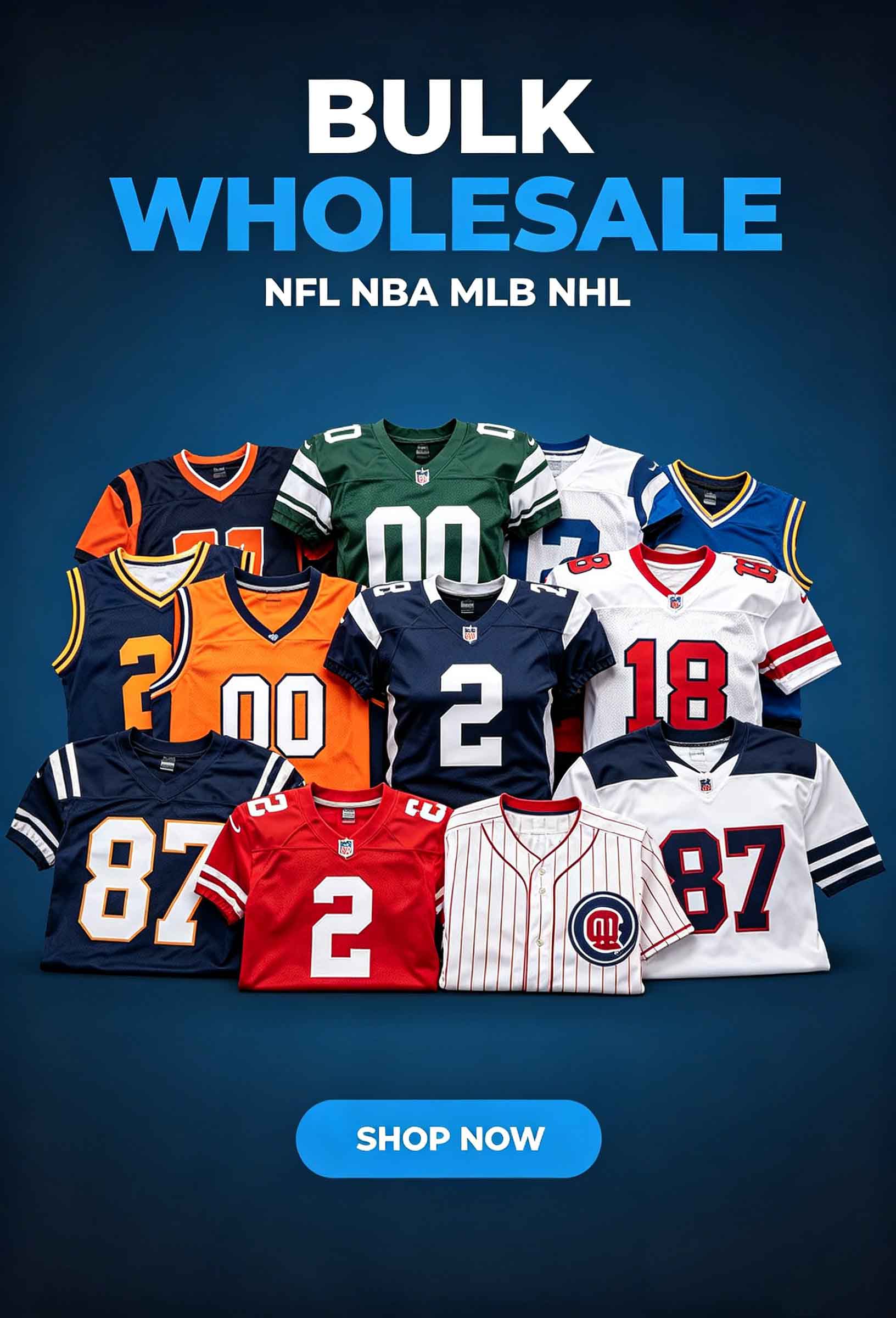
Most buyers searching how long do stitched NFL jerseys last are really asking one thing: will the garment survive 40 wash cycles without the numbers peeling, the collar curling or the mesh splitting at the shoulder seam. From inside a wholesale house shop, the honest number is 5 to 8 seasons of regular wear, and 10-plus years for a collector piece that never hits the dryer. That range only holds up when the build uses 300 GSM polyester mesh, double-stitched Tackle Twill numbers and reinforced collar bands — not heat-pressed vinyl that lifts after the first hot wash.
Dealers who route orders through three or four intermediaries rarely get that spec sheet. They get a photo, a price, and a shipping delay. The material gap shows up six months later when customers start filing returns, and the margin the buyer thought was locked in quietly disappears.
Start with fabric weight, because it determines everything downstream. A 300 GSM breathable polyester mesh holds its shape, resists snagging and drapes properly on the shoulder. Anything under 220 GSM feels like a practice pinnie and stretches out after a dozen wears. Ask any supplier for the GSM number in writing before you place a bulk order — if they can't produce it, they don't control their own production.
Number and name construction is the second durability checkpoint. Double-stitched Tackle Twill is cut, layered and sewn onto the garment with a satin stitch border. Heat-pressed alternatives bond to the surface and fail at the edges first. Twill costs more per unit at the factory level, but it eliminates the most common return reason in team apparel, which is far cheaper than processing refunds across a 200-piece order.
Look inside the jersey before you look at the outside. Soft interior backing sits behind every stitched number and letter so the embroidery thread never scratches skin during a full game. That single detail separates uniforms that get worn weekly from ones that get worn once and donated.
Collar and seam reinforcement matters just as much. Reinforced collar bands keep the neckline from rolling after repeated stretch, and zigzag lock stitching at the shoulders, armholes and hem holds under pulling and quick changes in the locker room. These are the exact stress points where cheap builds fail, and they are also the easiest places to inspect in a 30-second sample check.
So how long do stitched NFL jerseys actually last in circulation? Under normal rotation — worn once a week, washed cold, hung to dry — a properly built stitched jersey holds color and structure for 5 to 8 seasons. The mesh will fade slightly before the stitching gives out, and that fade is usually the point where a serious collector retires the piece and a casual fan keeps wearing it.
Washing habits shorten that window faster than any manufacturing flaw. Hot water, high-heat drying and chlorine bleach break down polyester fibers and stiffen Tackle Twill. Cold wash inside out, mild detergent, no fabric softener and air dry will roughly double the usable life of any stitched jersey you stock.
For resellers, that lifespan math has a direct commercial meaning. A garment that lasts six seasons generates repeat buyers, word-of-mouth and lower return rates. A garment that lasts six months generates support tickets, refunds and a damaged store rating. The unit cost difference between the two builds is usually 15 to 25 percent — a gap that any real dealer recovers within the first reorder cycle.
This is where warehouse-direct sourcing changes the numbers. When you buy stitched NFL jerseys straight from a House Shop that carries live inventory instead of drop-shipping from a third-party list, you get consistent specs across every batch, not a lottery of whatever the factory had on the floor that week.
- Fabric: 100% breathable polyester mesh, 300 GSM heavyweight body
- Numbers & letters: double-stitched Tackle Twill, layered construction
- Interior: soft backing panel behind all embroidery
- Collar: reinforced band, no roll after stretch
- Seams: zigzag lock stitching at shoulders, armholes and hem
- Trim: embroidered team logos and sleeve details
Bulk buyers should treat that list as an inspection template, not marketing copy. Pull three random pieces from any incoming shipment and check each item against those six points. If two of three samples fail on collar reinforcement or interior backing, reject the batch and request a re-cut. A warehouse that controls its own production will accept that standard. A trading desk that resells from a factory it has never visited will not.
Order volume is the next lever. Tiered wholesale pricing usually kicks in at defined quantity breaks, so mixing sizes and a few team styles inside one purchase order is the fastest way to reach the next discount tier without overstocking a single SKU. Youth and adult sizes can typically be combined, which matters for league and school accounts that need a full size run in one shipment.
Low minimum order quantities keep the risk small on first-time accounts. A distributor testing a new market can start with a limited run, confirm sell-through, then scale into full-case buying once the reorder data is clear. That staged approach protects cash flow and avoids the classic mistake of sinking a season's budget into a single style.
Lead time is the hidden cost nobody quotes. Domestic warehouses that hold live stock can turn a confirmed order in days, while overseas factory-direct shipments can take weeks plus customs. For league start dates and playoff runs, that difference decides whether a buyer delivers on time or eats a penalty clause.
Storage and care advice is worth passing down to your own customers, because it reduces returns. Keep jerseys folded or on wide hangers in a cool, dry space away from direct sunlight. Avoid plastic vacuum bags for long-term storage since trapped moisture degrades mesh and dulls embroidery thread. For stains, blot — never rub — with cold water and a mild detergent, then air dry away from heat.
Margin protection ultimately comes down to source control. Buyers who own their supply chain set retail pricing based on real landed cost, not a guess inflated by two layers of markup. That is the difference between competing on price and competing on price while still making money.
A final note on sizing, since it drives exchange volume. Most stitched NFL jerseys run true to standard athletic sizing, with a roomier cut through the chest and shoulder than fashion tees. If your customers are split between two sizes, stock the larger one heavier — oversized fit sells, and returns drop when buyers are not squeezing into a snug cut.
Do stitched NFL jerseys shrink after washing?
Minimal shrinkage, usually under 2 percent, when washed cold and air dried. Hot water and high-heat drying are what cause noticeable tightening, especially in the shoulder and sleeve length.
How many wash cycles before Tackle Twill numbers start to lift?
Properly double-stitched twill holds for 100-plus cold wash cycles. Lifting usually appears at the stitched border first, and it signals a low stitch-per-inch count rather than normal wear.
What is the difference between a replica and a stitched game jersey for bulk buyers?
A replica typically uses screen-printed or heat-pressed graphics and lighter fabric. A stitched game build uses layered Tackle Twill, heavier mesh and reinforced seams, which is the version that survives league play and repeat washing.
Can I mix teams and sizes in one wholesale order?
Yes. Mixed-team, mixed-size purchase orders are the standard way to hit higher quantity discount tiers without overcommitting to one style. Confirm the size-break rules with your supplier before the order is finalized.
If you are sourcing for a league, a retail chain or a distribution network, the fastest way to compare specs side by side is to look at live inventory rather than a PDF price sheet. Head to Jerseys Wholesale House Shop to browse the full NFL warehouse catalog, check tiered bulk pricing, confirm low MOQ terms and lock in factory-direct dispatch before your season window closes.