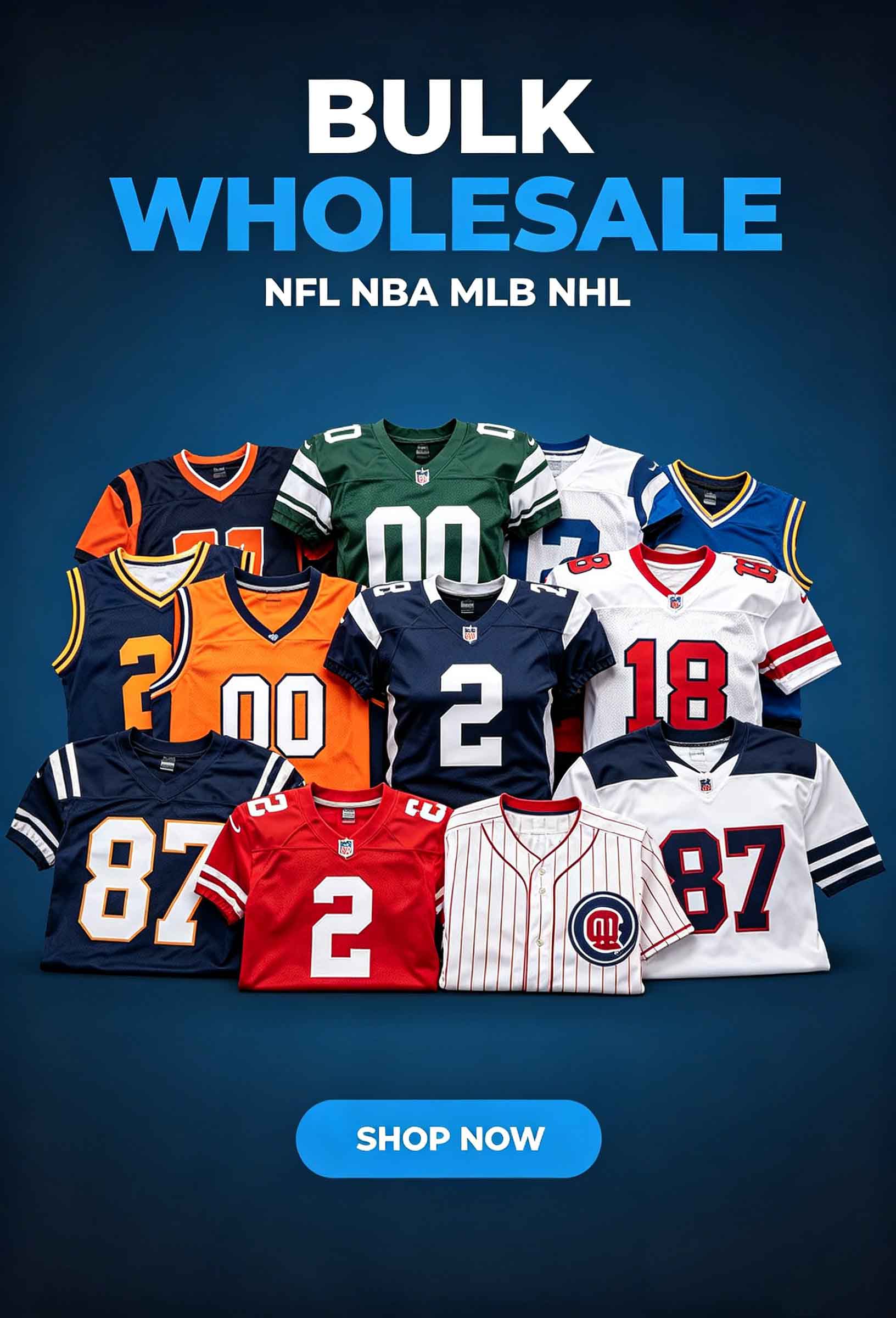
Custom stitched football jerseys bulk orders decide whether your store has a profitable season or a shelf full of dead stock. If you are sourcing through two or three middlemen, your landed cost is already too high before the first box ships. Jerseys Wholesale House Shop buys from the same factories that feed the licensed retail channel, holds the depth in our own warehouse, and sells to resellers, league managers, and team apparel buyers at factory-direct tier pricing.
The real problem is rarely finding a supplier. It is finding one that ships in 48 hours, keeps S through 5XL on the shelf, and does not send you a case of jerseys with crooked numbers and popped threads. Those three failures kill repeat business faster than any price increase.
Start with fabric, because it is the quickest way to spot a cut-corner operation. Wholesale-grade football jerseys run 100% breathable polyester mesh for the body panels, typically 300 GSM on the front and back, with lighter ventilated mesh through the side panels and underarm gussets. Lightweight mesh everywhere feels fine in the hand and turns transparent under stadium lights. Ask for the gram weight in writing before you place a bulk order.
Stitching is where cheap suppliers get exposed. Numbers, letters, and shoulder stripes should be applied as double-stitched Tackle Twill — layered fabric cut to shape, then sewn down with two parallel rows of thread. Single-stitch heat-sealed patches lift at the corners after three washes. Tackle Twill holds its edge through a full contact season, and it is the single feature customers inspect first when a jersey arrives in the mail.
Flip the jersey inside out next. A proper garment has soft interior backing behind every embroidered number and nameplate. Without that layer, the underside of the Tackle Twill scratches against bare skin, and you get returns. The backing should be fused flat with no curled edges and no exposed thread tails.
Collars take more abuse than any other panel. Look for reinforced collar bands with a ribbed knit and a double row of lock stitching at the seam. On V-neck and crew styles, the neckline should snap back to shape after stretching over a helmet or a padded shoulder. A floppy collar is the number one complaint on discount jerseys, and it is a construction problem, not a wear problem.
Seam construction matters just as much. Look for Z-stitch zigzag reinforcement at the side seams, sleeve hems, and the crotch of the armhole. That zigzag pattern lets the seam flex without snapping thread. Flat lock stitching on the shoulder yoke adds another layer of durability on game-weight builds.
- Body fabric: 100% breathable polyester mesh, 300 GSM heavyweight panels
- Decoration: double-stitched Tackle Twill numbers, letters, and nameplates
- Interior: soft backing layer behind all embroidery
- Collars: reinforced ribbed collar bands, double lock-stitched
- Seams: Z-stitch zigzag reinforcement at stress points
- Sizes stocked: S, M, L, XL, 2XL, 3XL, 4XL, 5XL in core colorways
Stock depth is the difference between a warehouse and a drop-shipper. Jerseys Wholesale House Shop keeps live inventory across the current NFL colorways, alternates, and throwback builds, so a 200-piece order does not turn into a four-week backorder. When you are sourcing custom stitched football jerseys bulk for a league, a team store, or a retail floor, size runs matter more than the headline price. A supplier that ships 40 mediums and 4 extra larges has just handed you a markdown problem.
Blank and custom programs both run through the same warehouse. Blank football jerseys ship immediately for buyers who handle their own decoration, and they carry a lower per-unit cost. Custom builds — names, numbers, sleeve patches, team wordmarks — go through a proofing step before production. Send a roster sheet with names, numbers, and sizes in a single spreadsheet and you cut the back-and-forth to one email.
Tiered pricing is where margin comes back. Unit cost drops at 25, 50, 100, 250, and 500 pieces, and the break points stack across styles in the same order. A reseller mixing 60 home jerseys, 40 alternates, and 30 throwbacks hits the 100-plus tier on the whole cart rather than paying full price on each style. That is the structural advantage of buying from a house with its own inventory instead of a broker who has to place a factory order first.
Minimum order quantity stays low on purpose. League managers testing a new design can start at 10 pieces on stock colorways, and team apparel buyers can test a new market with a small run before committing to a full season buy. Distributor buyers working at volume get a dedicated account contact and locked pricing.
Run this inspection checklist the first time you buy from any supplier, and again on every fifth bulk shipment:
- Pull one jersey per size and lay it flat — check number alignment against the placket
- Tug every embroidered corner; loose Tackle Twill shows up immediately
- Measure the chest and body length against the size chart, not against a retail jersey
- Wash one sample in cold water and air dry — check for color bleed and stitch pull
- Inspect three collars for stretch recovery after pulling
- Confirm the colorway code on the tag matches the packing list
Sizing trips up more bulk buyers than quality does. American football jerseys cut looser than a standard t-shirt because they layer over pads, so most buyers should order their normal size for a relaxed fit and size down for a fitted look. Youth sizing runs generous, which helps schools ordering for growing players. Always publish your own measurement chart in inches rather than reusing the manufacturer's, and you will cut fit-related returns by a wide margin.
Pass care instructions to your end customers and your return rate drops further. Machine wash cold, inside out, with like colors. Skip fabric softener, because it coats the mesh and dulls printed accents. Air dry is strongly preferred; if a customer insists on a dryer, low heat only, and pull the jersey out slightly damp. Never iron directly on embroidered numbers — press from the reverse side through a cloth if a wrinkle needs attention.
For stains, blot immediately rather than rubbing, which pushes pigment deeper into the mesh weave. A drop of mild dish soap and cold water handles most grass and food marks. For grease, apply a small amount of cornstarch first, let it sit, then brush it off before washing. Store folded rather than hung on wire hangers, which stretch the shoulder yoke over time. Stack clean jerseys in a breathable cotton bag or a dry closet away from direct sunlight, which fades the mesh faster than washing does.
Run the math on a typical bulk tier. A reseller landing stitched jerseys in the mid-teens per unit and selling at retail markup on a team store platform is working with a gross margin that absorbs shipping, payment fees, and a reasonable return rate — and still leaves real profit. The same jersey bought through a domestic distributor at two or three times the wholesale cost leaves almost nothing after fees. Volume does not fix a bad cost basis.
Turnaround and logistics close the loop. Stock items leave the warehouse within a short window after payment clears, and custom stitched runs move through proofing, production, and QC before dispatch. Order tracking goes out on every shipment, and bulk pallets ship with a packing list that matches the invoice line by line, which matters when you are receiving into a retail system or a league equipment room.
How long do stitched football jerseys last? A properly built Tackle Twill jersey with reinforced collars and soft interior backing holds up for multiple seasons of regular wear and washing. The failure points are always the same — single-stitched patches, thin mesh, and unprotected embroidery backs — and all three are avoidable at the buying stage.
Should I order blanks or fully custom? If you sell to multiple fan bases, blanks plus a local decorator gives you flexibility. If you supply a specific team, school, or league, order custom with the roster sheet attached and let the factory handle names and numbers.
What is the minimum for a first order? Stock colorways start at 10 pieces. Custom builds carry a higher minimum because of the setup step. Buyers ramping up usually start small on stock, confirm the fit and quality, then move into a custom run.
Do you ship outside the United States? Yes. Distributor buyers and overseas team apparel buyers order regularly, and bulk freight is quoted per shipment based on weight and destination.
Pull up the full Jerseys Wholesale House Shop NFL warehouse catalog to see live stock, tier pricing, and available size runs. Volume buyers get factory-direct cost, low minimums, and warehouse dispatch that keeps your shelves full through the season instead of three weeks into it.