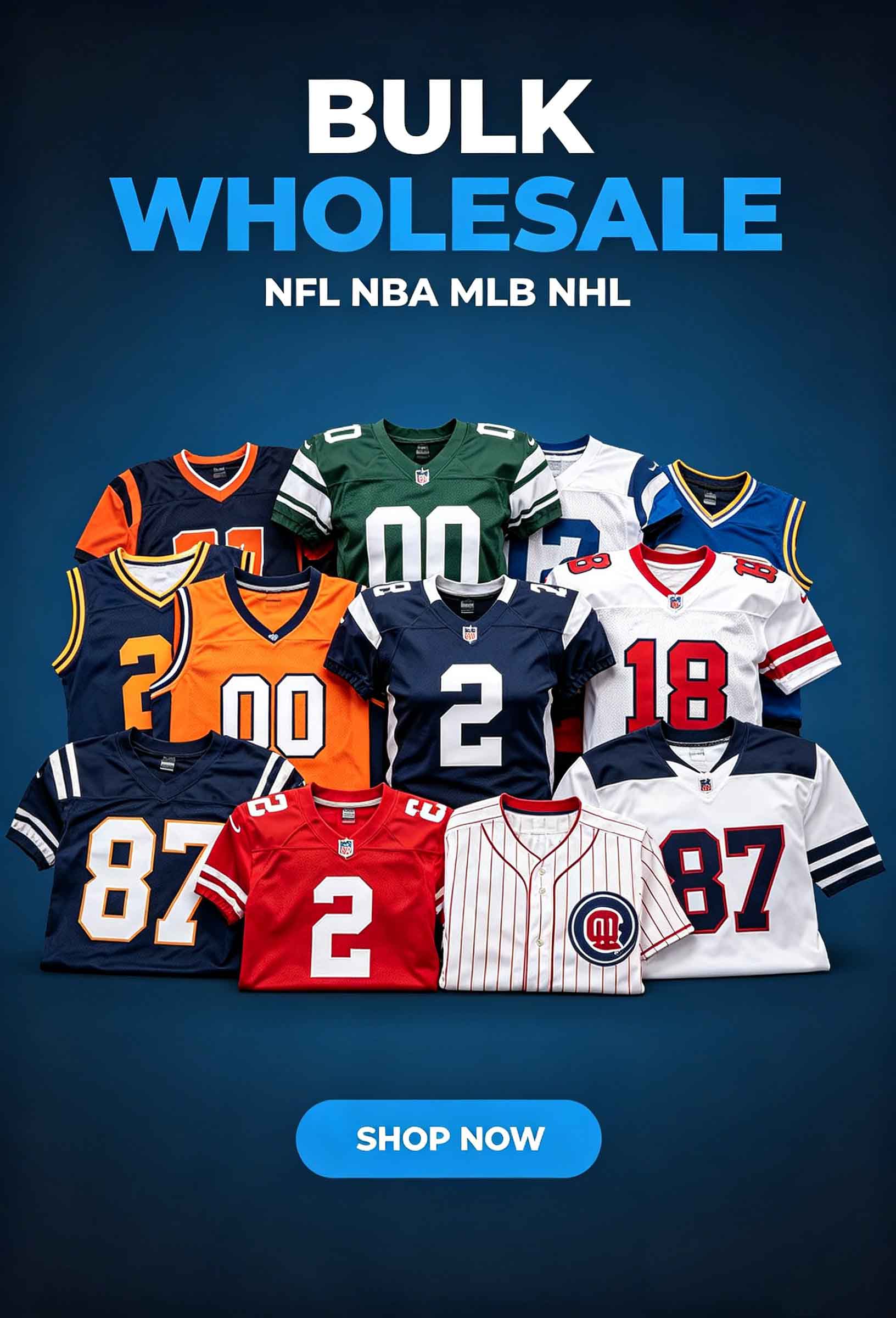
Blank basketball jerseys wholesale buyers are not shopping for a fashion item. They are shopping for inventory that turns over fast without locking cash into dead sizes. Most suppliers quote an attractive unit price, then bury you in 45-day production windows, 500-piece minimums per colorway, and a size curve that leaves you with twenty smalls and zero 2XL. The House Shop model was built to remove all three problems at the same time.
Blank does not mean unfinished. In the wholesale trade it means the panel build, collar trim, and armhole taping are completed and the body carries no player name or number. That gives a league manager room to assign roster numbers on their own timeline, and it gives a reseller a finished garment to run a screen-print or Tackle Twill program on top of.
Every blank pulled from our NBA racks is cut from the same pattern used on our lettered stock. There is no second-tier "blank line" with thinner fabric and looser tolerances. If you order blanks this month and embroidered stock next month, the shoulder seam hits the same place.
Fabric weight is the first thing to check on any quote sheet. Our bodies are built from 300 GSM 100% breathable polyester mesh, which is meaningfully heavier than the 180–220 GSM mesh common on promotional blanks. Heavier mesh keeps its shape after repeated laundering, drapes correctly across the shoulder, and does not go transparent under gym lighting.
Mesh hole structure matters as much as the weight number. An open-hole knit moves air through the panel instead of trapping it, which is why players stay comfortable through four quarters. Dense mesh also stitches cleaner. Twill sits flat on a tight weave instead of rippling around the edges after the first wash.
Here is the exact build sheet we run on blank stock:
- Body fabric: 300 GSM breathable polyester mesh, open-hole knit
- Applied graphics: double-stitched Tackle Twill, cut separately from the body panel
- Interior finish: soft backing layer behind all twill work
- Trim: reinforced collar bands, taped armholes, ribbed cuffs
- Stitching: Z-stitch bar tacks at stress points, 8–10 stitches per inch on main seams
- Size run: Youth S–XL and Adult S–4XL on a graded pattern
Double-stitched Tackle Twill is where a lot of cheap suppliers quietly cut corners. Single-stitch twill looks acceptable on a hanger and starts lifting at the corners after a dozen washes. Double-stitching runs the thread line twice around the perimeter of every number and letter, so the edge stays locked down even when the garment is pulled and stretched.
Cut edges on the twill are heat-sealed before application. That step stops the fraying that turns a clean number into a fuzzy outline. It also keeps the lettering crisp through commercial laundry cycles, which matters if you are supplying schools or municipal rec leagues.
Behind every stitched number sits a soft interior backing. Without it, dense twill work can feel abrasive against bare skin, and youth players complain first. The backing layer also stabilizes the fabric underneath, so the panel does not pucker where the needle passes through.
Collar and armhole construction gets overlooked until returns start coming in. Our reinforced collar bands use a rib knit with spandex content, which is why the neckline springs back instead of waving after a season. Armholes are taped, and stress junctions get Z-stitch bar tacks rather than a simple backstitch.
If you are sourcing multiple sport categories at once, the same construction standard applies across our floor. Buyers building a full storefront often pair blanks with bulk stitched basketball jerseys from the same warehouse so the quality story stays consistent across every listing they publish.
Sizing is the second most common source of disputes. Our blanks run true to standard US sizing, not the compressed Asian grading that shows up on some import quotes. Resellers who have been burned before should measure the chest one inch below the armhole and compare that number against the published chart, not against the size tag.
A flat size curve is a trap. For a typical rec league order, a 2:3:4:3:2 spread across S through 2XL moves fastest, with 3XL and 4XL ordered thin and reordered on demand. If your supplier cannot split a case by size, you end up funding their inventory instead of your own.
Quality control on bulk runs follows a written protocol, not a visual once-over. We pull samples at AQL 2.5, run a pull test on every twill edge, check colorfastness at grade 4 or better, and wash-test three cycles to confirm shrinkage stays under 3%. Anything outside tolerance gets flagged before it reaches a carton.
Dye lot consistency is the detail that separates a supplier you can reorder from one you cannot. Two shipments of navy from different dye houses will read as two different products on a shelf. We hold color standards on file per style and match every restock run against them.
Pricing is tiered, and the tiers are real. Minimum order quantity on blank stock starts low enough for a single team or a first-time test order, then breaks downward at the 50, 200, and 500 unit levels. The gap between tier one and tier four is what most resellers use to fund their ad spend.
Run the math before you commit. A blank landed at a factory-direct rate leaves room to sell a finished, stitched, name-and-number custom jersey at a retail price that still undercuts a licensed big-box equivalent. That spread is the entire business model, and it collapses the moment a middleman takes a cut.
Custom names and numbers are available on the same blanks. Stitched lettering is applied with the same double-stitch perimeter and interior backing as our stock numbers, so a personalized team set does not become a lower-grade product. Turnaround on stitched custom runs is quoted by quantity, not by guesswork.
Inventory depth is what keeps a storefront from going dark in October. We hold standing stock across the core colorways and restock on a fixed cadence rather than waiting for a production slot overseas. When a reseller sells out of a mid-size on a Friday, the replacement ships from the same warehouse floor.
Four mistakes show up again and again in first wholesale orders:
- Buying on unit price alone and ignoring fabric weight
- Ordering one flat size per style instead of a realistic curve
- Ignoring dye lot language in the purchase order
- Waiting until August to build fall league inventory
Give your retail customers a care sheet and your return rate drops. Cold wash inside out, mild detergent, no fabric softener, hang dry or tumble low. Fabric softener coats the mesh and kills the breathability that justifies the price point.
Stain removal is straightforward if it happens fast. Blot the area, apply a diluted dish soap solution with a soft brush, rinse cold, and air dry away from direct heat. Never use chlorine bleach on colored polyester, and never iron directly over stitched twill.
Storage matters for anyone holding stock through the off-season. Fold flat or hang on wide plastic hangers, keep garments out of direct sunlight, and avoid sealed plastic bags that trap moisture. A climate-controlled shelf beats a hot garage every time.
Seasonal timing drives allocation. Fall basketball programs start sourcing in July and August, and school orders land in September. Resellers who place tier-two orders before the rush get priority on restocks when the warehouse tightens in October.
Shipping is quoted by carton, and cartons are packed to a standard piece count so you can plan freight accurately. Domestic and international lanes are available, with consolidated shipping for buyers running multiple sports categories through one purchase order.
Choosing a supplier is really a question of which risks you want to carry. You can carry production risk, currency risk, and quality risk yourself with a direct import buy, or you can take stock that already cleared inspection. Most established resellers eventually land on the second option and put their capital into marketing instead of containers.
Do blank basketball jerseys shrink? Polyester mesh is dimensionally stable. Our wash testing holds shrinkage under 3%, and the number drops further if the garment is hung dry rather than run through a hot dryer cycle.
What is the difference between single-stitched and double-stitched twill? Single-stitch runs one thread line around the number's perimeter. Double-stitch runs two, which locks the edge and prevents the lifting and curling that shows up after repeated laundering.
What is the minimum order for blank stock? Tier one starts low enough for a single team or a test order. Pricing breaks again at 50, 200, and 500 units, and custom name-and-number runs are quoted separately by quantity.
How fast do bulk orders ship? In-stock blanks pull and ship from the warehouse floor on a short window. Stitched custom work adds production time that is confirmed at the quote stage, not after the order is placed.
If you are ready to stop absorbing middleman markup and long production windows, start with the Jerseys Wholesale House Shop warehouse catalog at www.jerseyswholesalehouse.shop. You will see live blank and stitched stock, tiered wholesale pricing that improves with volume, a low entry MOQ, and factory-direct dispatch from a floor that already passed inspection before the carton was sealed.