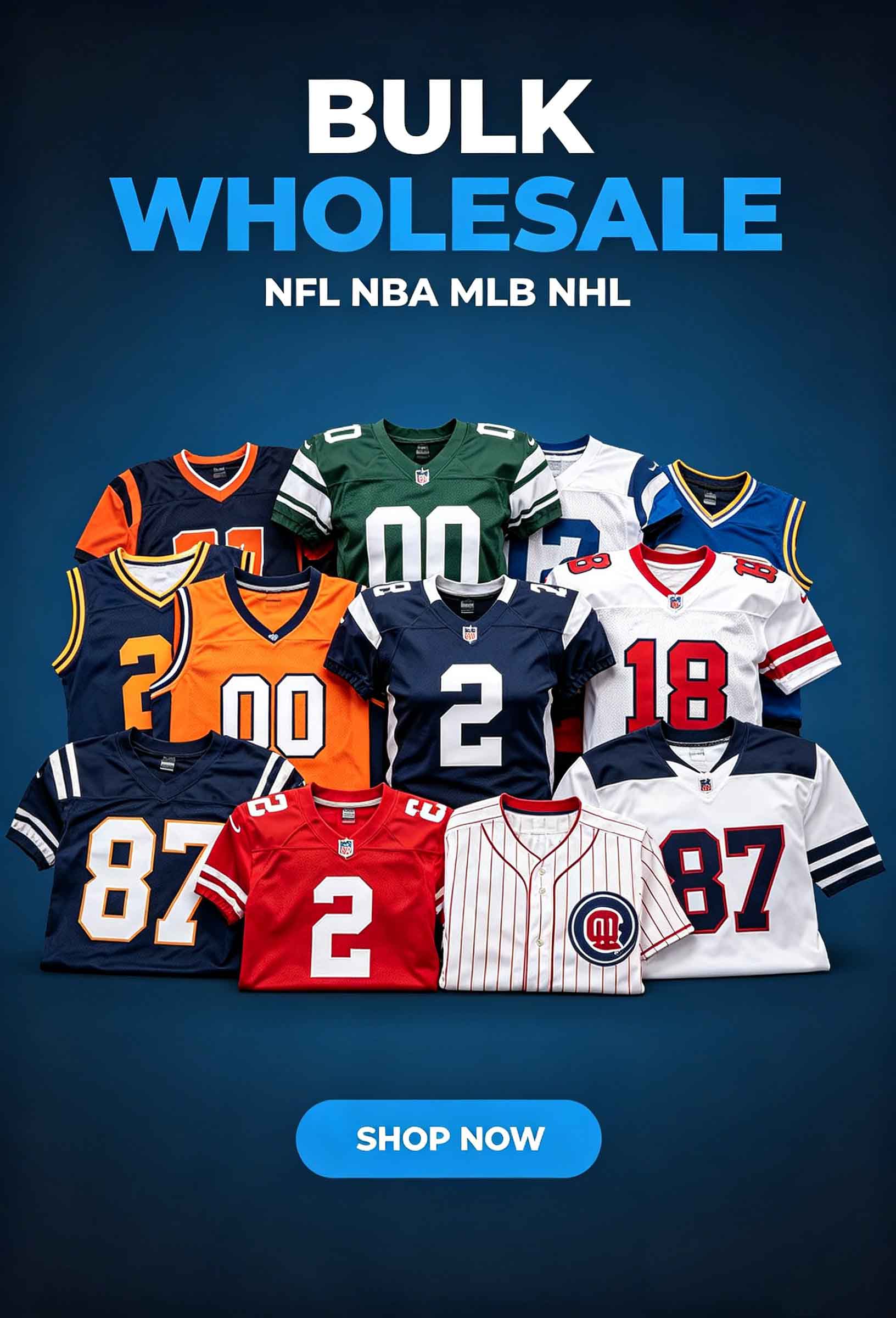
Buying custom stitched football jerseys bulk should not require guessing which of five trading companies is actually holding the inventory. When you buy through Jerseys Wholesale House Shop, you are buying from a warehouse floor that stocks the goods, cuts the sample, and ships the carton — not a broker who forwards your order to someone else. That single step removed is where most resellers find their real profit.
The markups that kill sports apparel resellers rarely show up as one big price jump. They show up as a sample fee here, a "custom name setup" charge there, a size-up surcharge on 2XL and 3XL, and a 45-day production window that forces you to sit on dead stock while a competitor restocks in a week. Stack those together and a jersey you should be buying at $18 lands in your hands at $29.
House Shop buying works differently because the goods are already built and boxed. Available stock sits in size runs from S through 3XL, plus youth cuts for league programs, and custom name and number orders are stitched in-house rather than outsourced to a third-party print shop.
Start with the fabric, because it decides your return rate. The standard body on our mesh football jerseys is 100% breathable polyester mesh at 150–160 GSM, with a 300 GSM heavyweight mesh option for buyers who want a heavier hand feel that survives a full contact season. Heavyweight mesh photographs better, hangs straighter on a hanger, and holds shape after repeated washes.
Stitching is where cheap suppliers hide problems. A jersey that looks fine in a product photo can fall apart at the third wash if the numbers are heat-pressed or glued. Ours are true double-stitched Tackle Twill numbers — layered twill sewn down with dense perimeter stitching, plus Z-stitch reinforcement at the shoulder seams and armholes, which is the zigzag bar-tack pattern that stops stress points from tearing under a shoulder pad.
Look inside the jersey next. Soft interior backing sits behind every embroidered and appliquéd area so the stitch tails never scratch a player's chest or snag on an undershirt. The collar uses reinforced collar bands instead of a thin ribbed strip that stretches out after two seasons. These are small specs on a spec sheet, but they are the exact reasons a team buyer reorders the same style three years running.
If you are still building a supplier shortlist, this is the category to compare carefully: custom stitched football jerseys bulk. Ask every vendor the same four questions — mesh weight, stitch type, backing material, and whether the neck tape is sewn or fused. Vendors that dodge those questions are usually selling pressed goods.
Wholesale floor stock is not one pile of jerseys. It separates into three buying paths, and knowing which one fits your business saves money on shipping and dead inventory:
- Blank football jerseys wholesale — plain mesh bodies with no numbers or names, ready for your own screen print, heat transfer, or local embroidery shop.
- Team football jerseys with custom names — roster-driven orders with stitched nameplates, numbers, and matching shoulder or sleeve detail.
- Stock team-styled jerseys — pre-built colorways and size runs for resellers who need product on a shelf this week, not next month.
Custom orders live or die on the roster sheet. Send your names and numbers in a locked spreadsheet — one column for the name exactly as it should appear, one for the number, one for the size — and confirm letter height and font before production starts. Nickname spellings, apostrophes, and suffix characters (Jr., III) are the three most common causes of a rejected batch, and they are all preventable at the file stage.
Quality control on bulk orders should be a written checklist, not a gut feeling. Pull a minimum of 10% of any carton and run these checks before the shipment leaves:
- Stitch density — count stitches per inch on numbers and nameplates; loose spacing means early fraying.
- Color match — compare against your approved swatch under daylight, not warehouse lighting.
- Size tolerance — flat-measure chest and body length on one unit per size; a 1-inch drift across a run shows up as customer complaints.
- Number alignment — front and back numbers should sit on the same vertical centerline and the same height off the shoulder seam on every unit.
- Trim and finish — check for loose threads, fused collars, and uneven hem stitching.
Size distribution is the most overlooked part of bulk buying. New resellers order flat — 10 of each size — and end up buried in smalls while medium, large, and XL sell out in a week. A realistic curve for adult football jerseys runs roughly 10% small, 20% medium, 30% large, 25% XL, and 15% split across 2XL and 3XL. Youth programs skew smaller and need a separate curve entirely.
Ask about size upcharges before you commit. Some suppliers add $2–$4 per unit on 2XL and 3XL, which quietly destroys your margin on the sizes that sell fastest at retail. House Shop tier pricing is built to keep larger sizes inside the same break, so your per-unit cost stays predictable across the full run.
Tiered pricing is where the math gets interesting. Entry-level bulk orders start at a low MOQ — enough to test a colorway without tying up working capital — and the per-unit price steps down at higher volume breaks. Once you cross into full-carton quantities, freight per unit drops too, and that is often a bigger saving than the product price itself.
Turnaround time matters as much as price. Pre-built stock orders are picked, packed, and dispatched from the warehouse within days, and custom stitched orders follow a production schedule that is quoted up front rather than left open. For resellers running a seasonal push, that predictability is worth more than shaving fifty cents off a unit.
Care instructions are a selling tool you should pass to your end customers. Football jerseys hold up far better when they are washed cold, inside out, on a gentle cycle, and hung to dry — dryer heat is what shrinks mesh and curls stitched numbers. Never bleach a colored jersey, and never iron directly over a Tackle Twill number; press from the reverse side with a cloth between the iron and the fabric.
For stain removal, treat the spot fast. Blot — do not rub — with a clean cloth, apply a small amount of mild liquid detergent and cold water, and let it sit for ten minutes before rinsing. Grass and mud come out easily on mesh. Grease marks from stadium food need a drop of dish soap worked in with a soft brush. Avoid chlorine-based cleaners, which dull the mesh finish and fade dyed twill.
Storage is simple but often done wrong. Fold jerseys flat or hang them on wide plastic hangers; thin wire hangers stretch the shoulder seams over time. Keep them out of direct sunlight, away from damp basements, and never store them sealed in non-breathable plastic bags for a full off-season — trapped moisture causes mildew that no wash will fully remove.
League and team buyers should also standardize. Once you approve a mesh weight, stitch style, and colorway, lock the spec and reference it on every reorder. Mixed specs across a season look inconsistent on the field, and inconsistent sets are the fastest way to lose a program account you spent months winning.
If you sell online, photograph the actual stitching. Close-ups of the Tackle Twill edge, the interior backing, and the collar band do more for conversion than a flat lay on white. List the GSM, the stitch type, and the size chart with flat measurements — accuracy cuts returns, and returns are what erase margin on low-ticket apparel.
FAQ
What is the minimum order for custom stitched football jerseys bulk?
Entry-level bulk pricing starts at a low MOQ so you can test a colorway before scaling. Custom rosters cost less per unit at higher volume breaks, and full-carton orders get the best freight rate.
How long do stitched football jerseys last compared to printed ones?
Stitched Tackle Twill numbers typically outlast pressed or printed graphics by several seasons. The twill is a separate fabric layer sewn through the mesh, so it does not crack, peel, or lift the way a heat transfer does after repeated washes.
Do these jerseys run big or small?
Mesh football jerseys generally run true to standard US sizing with a relaxed athletic cut. For a fitted look, most buyers go one size down; for wearing over shoulder pads, stay at the normal size. Always check the flat-measurement chart on the product page.
Can I order blanks and add my own numbers later?
Yes. Blank football jerseys wholesale is the most flexible route for screen printers and local embroidery shops. Order blanks in your size curve, then apply numbers and names in-house or through a local finisher.
Restocking a team store or filling a league order should not depend on a supplier's production calendar. Browse the full House Shop warehouse catalog, compare tier pricing across mesh weights, and lock your size curve before the season starts — see what is sitting on the floor right now at Jerseys Wholesale House Shop. Low MOQ to start, stepped bulk discounts as you scale, and factory-direct dispatch with no middle layer standing between your order and your margin.