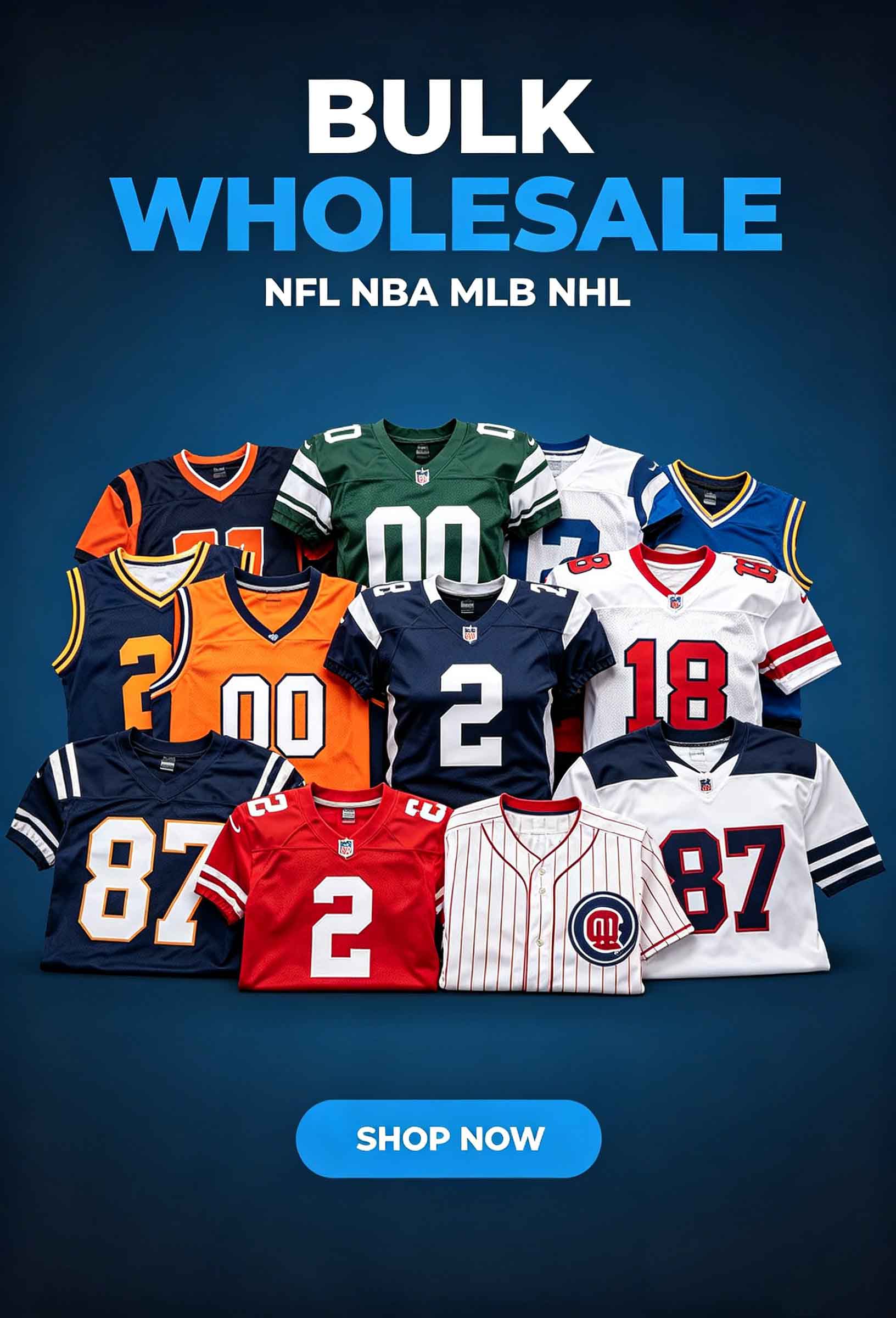
If you source custom stitched football jerseys bulk for a league, a team store, or a distributor network, the margin math decides whether the account survives past one season. Jerseys Wholesale House Shop exists for that exact order profile: factory-direct NFL stock, tiered bulk pricing, and stitched construction that holds up through a full schedule of wear and washing.
Most buyers get squeezed between two bad options. They either pay a broker two or three layers of markup, or they gamble on a low-cost supplier who ships in six weeks with loose embroidery, shorted sizes, and faded panels by October. Both outcomes cost you repeat customers, and repeat customers are where the real revenue sits.
The house shop model removes the broker layer entirely. Stock sits in our warehouse in bulk, packed by team, colorway, and size run, ready for pallet or carton dispatch. When you place a reorder, you are not waiting on a factory to schedule a production run. You are pulling from inventory that already passed incoming inspection.
Fabric is the first thing to check on any stitched football jersey. Our game and replica-tier builds use 100% breathable polyester mesh at 300 GSM heavyweight weight, not the 180–220 GSM tissue paper that shows up on cheap imports. The heavier knit gives the jersey body, keeps the number panels flat, and holds shape after a dozen wash cycles.
Mesh density also affects how the jersey photographs. Pro shops and resellers selling online know that a jersey which drapes properly moves inventory faster than one that hangs like a bedsheet. Higher GSM mesh reads as legitimate in listing photos, which cuts your return rate.
Numbers and letters are double-stitched Tackle Twill, layered and sewn, not heat-pressed vinyl. Heat transfer peels at the corners after a few washes, and it looks flat under gym lighting. Embroidered twill has depth, holds color saturation, and survives the dryer. Every panel is stitched with a tight zigzag border and a second pass along the anchor points where stress concentrates.
Inside the jersey, you will find a soft interior backing behind every stitched zone. This is the layer that stops embroidery thread from scratching the chest and shoulders. It is also the detail most low-cost suppliers skip, and it is the first thing a player notices when they pull the jersey on.
Collars get reinforced collar bands with a ribbed knit that resists stretching out. The shoulder seams and armhole bindings are bar-tacked at the stress points, and the hem carries a double-fold finish so it does not roll. These are small construction choices, but they are the difference between an account that reorders in November and one that does not.
For custom work, twill nameplates are sewn rather than glued, with lettering cut to the correct height and tracked spacing. If you need team football jerseys with custom names, we stitch the plate to the back panel with a perimeter stitch and two cross-stitch anchors. Nothing lifts after the first wash.
Incoming inspection runs on a documented sampling plan. Before any bulk order leaves the floor, we pull cartons against a fixed checklist:
- Stitch density: minimum stitch count per inch on all twill borders, checked at four points per jersey
- Color match: dyed mesh compared against the approved swatch under both daylight and store lighting
- Measurement tolerance: chest, body length, and sleeve openings held to ±0.5 inch against the size spec
- Trim alignment: collar band centered, sleeve stripes level, nameplate square to the shoulder seam
- Thread tails: zero loose ends on the interior facing, no skipped stitches on curves
Ask your supplier for their stitch-per-inch numbers before you commit to a large PO. If they cannot answer that question, they are not running an inspection line, and you will be the one absorbing the defect claims.
Size curve planning is where a lot of wholesale buyers lose money. A flat buy across M, L, and XL will leave you sitting on smalls and sold out of the two sizes that actually move. Football buyers skew heavy. A working curve for most reseller accounts runs roughly 10% S, 20% M, 30% L, 25% XL, 10% 2XL, with 3XL and 4XL ordered against confirmed pre-orders only.
For youth programs, run a separate curve entirely. Youth sizes sell in clusters around YM and YL, and youth stitched builds should use the same mesh weight with a lighter twill panel so the jersey does not feel stiff on smaller frames.
Bulk pricing works on tier breaks rather than a flat unit number. Your per-unit cost drops as the order quantity climbs, and mixing teams inside one tier is allowed because the pick labor is the same. That means a league manager buying eight different teams can still hit the higher discount tier instead of splitting the order into eight small POs.
Reorder velocity is the metric most buyers ignore until it hurts them. Keep a two-week buffer of your top three selling teams. Divisional playoffs, trade news, and draft weekend all spike demand with roughly 48 hours of warning. If your supplier needs a production window, you miss that wave completely. Warehouse-stocked custom stitched football jerseys bulk programs solve this because the goods are already bagged and shelved.
Care guidance is worth passing along to your end customers, because it protects your margin on returns. Tell them to wash inside out in cold water, skip the fabric softener, and air dry the stitched zones. Fabric softener coats the mesh and dulls the twill over time. A jersey treated this way will hold its shape and color far longer than a heat-pressed alternative.
For stain removal, blot the area with cold water and a drop of mild detergent before it sets. Do not scrub twill with a brush, and never run a hot iron directly across embroidery. A pressing cloth and low heat from the inside will flatten shipping creases without melting the thread.
Storage matters for retail stock too. Fold jerseys flat in poly bags, keep them out of direct sun, and avoid hanging stitched pieces on wire hangers for long periods. Wire distorts the shoulder line, and a distorted shoulder is the first thing a customer sees on the rack.
Lead time is the other half of the value equation. Domestic warehouse dispatch on in-stock SKUs runs on a short turnaround, while custom stitched runs follow a quoted production window. Plan your custom orders against your selling calendar, not against your cash flow calendar. Orders placed the week before a season opener will always be tight.
If you run a throwback or vintage program, note that older-style builds use the same mesh and twill construction with retro-specific trim, so the durability is identical to current stock. Collectors and retro buyers are pickier about trim accuracy than about fit, so confirm the shoulder stripe and collar shape against reference photos before you commit.
Finally, treat your wholesale supplier as a production partner, not a vending machine. Give them your size curve history, your top teams, and your reorder triggers. A supplier with warehouse visibility can hold the right stock for you before you need it, which is the entire point of buying from a house shop instead of a broker.
Start with a sample order, run your own inspection against the checklist above, and confirm the stitch density yourself. Once the construction checks out, scale into tier pricing and lock your size curve.
When you are ready to move, browse the full Jerseys Wholesale House NFL stock at www.jerseyswholesalehouse.shop and request a bulk quote with your team list, size curve, and target quantity. Low MOQ entry, tiered wholesale discounts, factory-direct pricing, and warehouse dispatch on in-stock SKUs are all standard. Send the PO, and we will confirm availability the same business day.
FAQ
Do stitched football jerseys run big or small?
Our builds are cut to standard US sizing with a relaxed body. Most buyers order true to size for game wear and one size up for layered wear. Youth sizing runs true with a slightly shorter body length.
How long do stitched jerseys last compared to heat-pressed?
With cold-water washing and air drying, double-stitched Tackle Twill panels typically outlast heat-pressed graphics by several seasons. The failure point on pressed jerseys is adhesive breakdown, which stitched construction does not have.
Can I mix teams and sizes inside one bulk order?
Yes. Mixed team and size assortments count toward the same tier break, which is how league managers and multi-team resellers reach the deeper discount without splitting the order.
What is the minimum order for custom names and numbers?
Custom stitched runs start at a low MOQ per design, and blank stock can be ordered in smaller quantities for immediate resale. Send your roster or team list and we will confirm the tier and production window.